Oil-Filled Heater vs Ceramic Heater: Which Is Cheaper to Run?
Neither is cheaper: at the same watts, both cost about $0.27 an hour on high (1,500 W), or $65 a month at 8 hours a day, at the U.S. average electricity price. Pick by how you heat: ceramic for fast heat in short bursts, oil-filled for quiet, steady heat for hours.15
One safe pick of each type

Ceramic: for fast heat
Dreo Atom 316 (HSH006) ceramic heater
$35.96 on Amazon
Check price on Amazon1,500 W · ETL mark · tip-over and overheat shutoff · timer · 34 dB
- Our top space heater pick. A fan blows air over the hot ceramic, so you feel warm in minutes.
- Its listing states a thermostat, a timer, tip-over and overheat shutoff and an ETL mark.
- Best for a desk, an office or a room you use for an hour or two.

Oil-filled: for quiet, steady heat
Comfort Zone digital oil-filled radiator with remote
$89.67 on Amazon
Check price on Amazon1,500 W · ETL mark · tip-over and overheat shutoff · timer · no fan
- Our top oil-filled pick. No fan, so no fan noise, and it stays warm for a while after it shuts off.
- Its listing states a thermostat, a timer, tip-over and overheat shutoff and an ETL mark.
- Best for a bedroom or a room you sit in for hours. Use the timer: the CPSC says to turn heaters off when you sleep.
Prices are Amazon's on November 4, 2026. Both picks are sold by Amazon. They are the top picks on our space heater and oil-filled heater pages.
In your state, 1,500 W costs from $0.19 an hour in North Dakota to $0.69 in Hawaii. A thermostat that switches the heater off when the room is warm lowers the bill for either type. See your state.
01 / Cost by state
What each one costs to run in your state
These costs are the same for an oil-filled or a ceramic heater on 1,500 W. They assume the heater runs the whole time; a thermostat that cycles it off makes the real cost lower. How much lower depends on the room, not the heater type.5
| State | ¢/kWh | Per hour | Month, 4 h/day | Month, 8 h/day |
|---|---|---|---|---|
| U.S. average | 18.2 | $0.27 | $33 | $65 |
| Alabama | 16.5 | $0.25 | $30 | $60 |
| Alaska | 27.1 | $0.41 | $49 | $98 |
| Arizona | 15.4 | $0.23 | $28 | $56 |
| Arkansas | 13.6 | $0.20 | $24 | $49 |
| California | 33.2 | $0.50 | $60 | $120 |
| Colorado | 16.7 | $0.25 | $30 | $60 |
| Connecticut | 28.0 | $0.42 | $50 | $101 |
| Delaware | 17.9 | $0.27 | $32 | $64 |
| District of Columbia | 24.7 | $0.37 | $44 | $89 |
| Florida | 15.3 | $0.23 | $28 | $55 |
| Georgia | 15.4 | $0.23 | $28 | $55 |
| Hawaii | 46.3 | $0.69 | $83 | $167 |
| Idaho | 13.0 | $0.19 | $23 | $47 |
| Illinois | 19.2 | $0.29 | $35 | $69 |
| Indiana | 17.0 | $0.26 | $31 | $61 |
| Iowa | 14.2 | $0.21 | $26 | $51 |
| Kansas | 15.2 | $0.23 | $27 | $55 |
| Kentucky | 14.3 | $0.21 | $26 | $51 |
| Louisiana | 13.3 | $0.20 | $24 | $48 |
| Maine | 30.0 | $0.45 | $54 | $108 |
| Maryland | 21.3 | $0.32 | $38 | $77 |
| Massachusetts | 30.1 | $0.45 | $54 | $109 |
| Michigan | 21.5 | $0.32 | $39 | $78 |
| Minnesota | 16.2 | $0.24 | $29 | $58 |
| Mississippi | 15.2 | $0.23 | $27 | $55 |
| Missouri | 14.0 | $0.21 | $25 | $50 |
| Montana | 13.9 | $0.21 | $25 | $50 |
| Nebraska | 12.9 | $0.19 | $23 | $46 |
| Nevada | 13.5 | $0.20 | $24 | $49 |
| New Hampshire | 26.8 | $0.40 | $48 | $96 |
| New Jersey | 24.0 | $0.36 | $43 | $86 |
| New Mexico | 15.1 | $0.23 | $27 | $54 |
| New York | 29.4 | $0.44 | $53 | $106 |
| North Carolina | 14.9 | $0.22 | $27 | $54 |
| North Dakota | 12.4 | $0.19 | $22 | $44 |
| Ohio | 18.7 | $0.28 | $34 | $67 |
| Oklahoma | 13.6 | $0.20 | $24 | $49 |
| Oregon | 15.4 | $0.23 | $28 | $55 |
| Pennsylvania | 21.0 | $0.32 | $38 | $76 |
| Rhode Island | 29.2 | $0.44 | $53 | $105 |
| South Carolina | 15.9 | $0.24 | $29 | $57 |
| South Dakota | 14.5 | $0.22 | $26 | $52 |
| Tennessee | 13.9 | $0.21 | $25 | $50 |
| Texas | 16.1 | $0.24 | $29 | $58 |
| Utah | 13.2 | $0.20 | $24 | $47 |
| Vermont | 23.9 | $0.36 | $43 | $86 |
| Virginia | 16.8 | $0.25 | $30 | $61 |
| Washington | 14.4 | $0.22 | $26 | $52 |
| West Virginia | 15.5 | $0.23 | $28 | $56 |
| Wisconsin | 19.0 | $0.28 | $34 | $68 |
| Wyoming | 13.9 | $0.21 | $25 | $50 |
Per hour = 1.5 kWh × the state's average home electricity price (EIA, year to date through July 2026). A month = 30 days. Compare with your furnace or a heat pump: space heater cost vs your furnace.
02 / Best sellers
The best sellers of each type, side by side
These are the most-bought ceramic and oil-filled heaters on Amazon's first search page (40K+ and 2K+ bought in the past month). Each one's settings are its listing's own words. At the same setting, each costs the same per hour.89
| Heater | Type | Bought a month | Settings | Noise | Safety screen | Per hour | Buy |
|---|---|---|---|---|---|---|---|
 Dreo Atom 316 (HSH006) | Ceramic | 40K+ | 1,500 W; ECO and fan-only modes | 34 dB (fan) | Passes | $0.27 high | Buy · $39.99 |
 Amazon Basics DQ1927-Y | Ceramic | 20K+ | 1,500 W high, 900 W low, fan only | 43 dB (fan) | Listing does not state a UL, ETL or CSA mark | $0.27 high$0.16 at 900 W | Buy · $20.69 |
 Amazon Basics CY62RR-7 | Oil-filled | 2K+ | 1,500 W high, 900 W medium, 600 W low | No fan | Passes | $0.27 high$0.11 at 600 W | Buy · $70.19 |
 Dreo DR-HSH010 | Oil-filled | 2K+ | 1,500 W, 900 W or 600 W, plus ECO | No fan | Passes | $0.27 high$0.11 at 600 W | Buy · $99.99 |
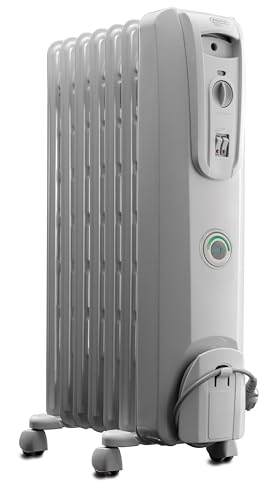 De'Longhi EW7707CM | Oil-filled | 2K+ | 1,500 W; ComfortTemp mode | No fan | Listing does not state tip-over shutoff or a UL, ETL or CSA mark | $0.27 high | Buy · $129.95 |
Safety screen: the listing states a thermostat, tip-over and overheat shutoff and a UL, ETL or CSA mark, the same screen as our space heater page. The three oil-filled heaters tie at 2K+, so all three are shown.
What each setting costs
The watt settings these best sellers state, at the U.S. average of 18.19¢ per kWh.
| Setting | Per hour | Month, 8 h/day | Best sellers with it |
|---|---|---|---|
| 1,500 W | $0.27 | $65 | 5 of 5 |
| 900 W | $0.16 | $39 | 3 of 5 |
| 600 W | $0.11 | $26 | 2 of 5 |
03 / The evidence
Why oil-filled does not cost less to run
Both are electric resistance heaters. The DOE says resistance heat is "100% energy efficient in the sense that all the incoming electric energy is converted to heat." So a 1,500 W oil-filled heater and a 1,500 W ceramic heater make the same heat and cost the same for every hour they run.1
A public power district says the same in plain words: whether oil-filled, ceramic, quartz or standard, "they all use electric resistance heat which is considered 100 percent efficient."3
What the oil does: the DOE says the oil "provides some heat storage, allowing the heater to cycle less and to provide a more constant heat source." That means fewer on-and-off swings and more even warmth. It does not say the heater uses less power.2
Warm-up and leftover heat cancel out. An oil-filled heater spends power warming its oil before the room feels warm, then gives that heat back after it shuts off. You pay for that heat either way.
None of the sources we read (the DOE, the power district, and the GreenCalculus, 4Homes and OwnerSpec guides ChatGPT reads for this question) gives a test showing one type using less electricity than the other to keep a room at the same temperature. So we do not claim a saving for either.
04 / Listing claims
What the listings claim, and what it means
Several best sellers say they save energy. Here is each claim, in the listing's words, and what is behind it.9
- Amazon Basics CY62RR-7“By gradually releasing heat over time, radiator heaters are more energy efficient, helping lower your heating costs.”The listing gives no test. The heat it releases later was paid for while it was heating, so it is not free heat.
- Dreo DR-HSH010“boosting efficiency by 92.3%”The listing does not say 92.3% of what, or compared with what. No electric heater turns more than 100% of its power into heat.
- De'Longhi EW7707CM“Up to 20% more efficient* deploy the ComfortTemp feature (*versus using the same unit thermostat at max setting without ComfortTemp)”The fine print says the 20% is against the same heater with its thermostat on max. The saving comes from running it lower, which you can do with any heater's thermostat.
- Dreo Atom 316 (HSH006)“saving you energy while keeping you comfortable”This is the thermostat at work: it switches the heater off when the room reaches your setting. Any heater with a thermostat does the same.
- Amazon Basics DQ1927-Y“Ceramic heating provides fast and efficient heat in minutes”Fast, yes: a fan blows air over the hot ceramic. "Efficient" means nothing extra here; every electric heater turns all its power into heat.
05 / Lower the bill
What actually lowers the bill
- Set the thermostat, then leave it.The DOE says to choose a heater with a thermostat "because they avoid the energy waste of overheating a room." Every heater on this page has one.2
- Use a lower setting.At 900 W a heater costs about $0.16 an hour; at 600 W, about $0.11. 2 of the 3 oil-filled best sellers state a 600 W setting.5
- Run it fewer hours.A ceramic heater warms the air faster, so for a short stay you can switch it off sooner. We found no measured warm-up times, so we give no number.
- Heat only the room you are in.The DOE says a small space heater can be less expensive "if you only want to heat one room." That only saves money if you turn the central heat down.2
For a room you heat all winter, a heat pump or mini split costs less than either. The DOE says heat pumps "easily cut electricity use by 50%" compared with electric resistance heat.1 See DIY mini splits or the cost in your state.
06 / By room
Which one for your room
- BedroomOil-filled. It has no fan noise and gives even heat. Warm the room, then turn it off before you sleep, or let the timer do it.
- Desk or home officeCeramic. It warms you in minutes, and you can switch it off when you leave.
- Living room or open roomEither. No plug-in heater makes more than 1,500 W, enough for about 150 sq ft. For a bigger room, run two on different circuits.
- BathroomNeither of our picks. Use a heater made for bathrooms with a shock-guard plug. The Amazon Basics ceramic listing says to avoid bathrooms.
More picks by room, including bathroom heaters: best space heaters · best oil-filled radiator heaters.
07 / Safety
Safety rules for both types
Both picks state every feature below. How you use the heater matters just as much.
- Plug it straight into a wall outlet. “Plug electric space heaters directly into a wall outlet—never into an extension cord or power strip.” (CPSC)
- Keep it 3 feet from anything that can burn. “Keep portable heaters at least three feet away from drapes, furniture, bedding and other combustible materials” (CPSC)
- Turn it off when you sleep or leave the room. “Turn off heaters when sleeping.” (CPSC)
- Buy one that shuts off if it tips over. “Buy a unit with a tip-over safety switch, which automatically shuts off the heater if the unit is tipped over.” (DOE)
- Stop using an oil-filled heater that leaks. “Welds in the heating fins can break, allowing oil to leak. This poses a burn and fall hazard to consumers.” (CPSC)
08 / Questions
Frequently asked
- Is an oil-filled heater cheaper to run than a ceramic heater?
- No. At the same watts they cost the same per hour, because both turn all their power into heat (DOE). A 1,500 W heater of either type costs about $0.27 an hour on high at the U.S. average price. The oil stores some heat so the heater cycles less, which makes the warmth more even, not cheaper.
- How much does it cost to run a 1,500 W heater for a month?
- About $65 at 8 hours a day, or $33 at 4 hours a day, at the U.S. average of 18.19¢ per kWh (EIA). That assumes it runs the whole time. In North Dakota it is about $44 at 8 hours a day; in Hawaii, about $167.
- Does an oil-filled heater keep heating after it turns off?
- Yes, for a while. The DOE says the oil provides some heat storage. But that heat was made with power you already paid for, so it is not free heat.
- Which heats a room faster?
- A ceramic heater. Its fan blows air across the hot ceramic, so you feel the heat in minutes. An oil-filled heater has to warm its oil first.
- Which is better for a bedroom?
- An oil-filled heater, because it has no fan noise. The CPSC says to turn heaters off when you sleep, so warm the room first or use one with a timer.
- Do "ECO" modes save money?
- Only by running the heater less, through the thermostat or a lower setting. No electric heater makes more heat per watt in ECO mode; the DOE says all of their power already becomes heat.
- Is a heat pump cheaper than either?
- Yes, per unit of heat. The DOE says heat pumps "easily cut electricity use by 50%" compared with electric resistance heaters like these. Our space heater cost page compares them in your state.
How we did this
Method
Cost is arithmetic, not a test: watts ÷ 1,000 × hours × the EIA price. We did not run any heater.
Best sellers are the top results by Amazon's "bought in past month" badge on the first search page, read once. Badges are rounded.
Settings, noise and claims are quoted from each listing and checked against it when the page is built. A listing that names no watts for a lower setting shows only its high setting.
More on how we work: our methodology.
References
Sources
- 1
- 2
- 3
- 4
- 5
- 6
- 7
- 8
Amazon search results: "bought in past month" badges
- 9
Amazon listings: watts, settings, noise and safety features as each listing states them