Best tankless water heater · AHRI directory and the DOE test checked 2026-09-19
Best Tankless Water Heater: 39 Amazon Bestsellers Checked Against the AHRI Directory
993 AHRI-certified instantaneous rows · 39 Amazon bestsellers decoded · 5 standards, 2 field studies, 1 lab comparison and 4 recall notices read · six certified picks, priced on 2026-09-19
Buy on the certified flow at the certified rise, and on what your gas line or your panel can feed. Gallons per minute is not a property of the heater; it is a property of the heater and the temperature you ask it to add. The DOE test certifies maximum flow at a 67°F rise (58°F in, 125°F out), and the boxes print a figure at a 35°F rise, or at no stated rise, which is why Rheem's "8.4 GPM" is certified at 4.4 and its "5.9 GPM" electric at 2.4. Of 39 Amazon bestsellers, 12 are on the AHRI directory (Rheem, Rinnai); every listed unit that prints a flow prints 1.7 to 2.8 times its certified one, and 27 units, 17 of them gas, are on no directory at all. Electric whole-house units are a panel question before they are a hot-water question: 24 kW is 100 A on three 40 A breakers and a 200 A service, per Rheem's own listing. The one independent field study found tankless gas units saved 37% on water heating and paid back in 20 to 40 years at 2010 prices.
- "8.4 GPM" is 4.4
- the rise decides
- electric needs the panel
- check the AHRI listing
- six certified picks
The picks at a glance · certified figures, Amazon prices on 2026-09-19
-
Best whole-house gas
Rheem RTG-84XLN-3 (outdoor)
$964.10 · 4.4 GPM certified at a 67°F rise (box says 8.4) · UEF 0.82 · 180,000 BTU/hr · sold by Amazon.com
4.4 GPM certified at the 67°F test rise, the most of any unit Amazon itself sells; the "8.4" on the box is Rheem's 35°F figure. UEF 0.82, outdoor, no vent kit, sold by Amazon.
Check price on Amazon -
Best electric, if the panel allows
Rheem RTEX-24
$549.00 · 2.4 GPM certified at a 67°F rise (box says 5.9) · UEF 0.93 · 24 kW, 100 A at 240 V · sold by Amazon.com
2.4 GPM certified, 100 A draw on three 40 A breakers and a 200 A service. The box's "5.9 GPM" is a 28°F rise. One shower in winter, two in Florida.
Check price on Amazon -
Best point of use
Rheem RTEX-06T
$189.00 · 0.5 GPM certified at a 67°F rise · UEF 0.94 · 6.5 kW, 27 A at 240 V · sold by Amazon.com
0.5 GPM certified for a distant sink, $189, sold by Amazon. Not a shower, whatever "tankless" suggests.
Check price on Amazon
The picks by system type, with the reasoning, are in section 08. Affiliate links; we earn a commission at no cost to you.
01 / What this page adds
Nine numbers from the directory, the listings, the spec sheets and the field study
Four are computed from the decode table lower on the page, one is the certified directory itself, four are measured, specified or ruled by someone else and link to the document.
- 12 of 39
12 of the 39 bestselling tankless water heaters on Amazon are on the AHRI directory, all of them Rheem or Rinnai. The other 27 are not, and 17 of those burn gas or propane: APUS, Baococo, Camplux, GASLAND, MIZUDO, NOVIEEX, Ranein, VEVOR, Westinghouse, thermomate. A listing on AHRI is voluntary; the DOE certification report a maker must file before selling a water heater is not, and none of these listings says whether one exists. 1
The top results for six Amazon searches on 2026-09-19, deduplicated to 39 ASINs and matched by brand and model code against the 993 Instantaneous rows of the AHRI directory in the site corpus (663 gas and propane, 330 electric).
- 1.7× to 2.8×
Every AHRI-listed unit that prints a flow prints more than it certifies: 11 of 11, by 1.7 to 2.8 times, median 2.1. Rheem's RTG-84 says 8.4 GPM and certifies 4.4; the RTG-70s say 7.0 and certify 4.0; the RTEX-24 electric says 5.9 and certifies 2.4; Rinnai's RE199 says 9.8 and certifies 4.6. None of the numbers is false. Rheem states its gas figures at a 35°F rise in the bullets; the certified figure is at 67°F. 1
Box figure from each listing's title or first bullet, certified figure from the directory. 8 of the 30 listings that print a flow state the rise it was measured at; 22 print a maximum or a bare number.
- 500 × GPM × °F
The arithmetic behind every flow claim: gallons per minute × 500 × degrees of rise = BTU per hour delivered. Rheem's 180,000 BTU/hr burner, at the recovery efficiency the directory lists for it, comes to 8.7 GPM at 35°F, 4.6 at 67°F and 4.4 at the 70°F rise a 45°F winter inlet asks for, against 8.4 on the box and 4.4 certified. An 18 kW electric unit delivers 61,416 BTU/hr: 3.5 GPM at 35°F, 1.8 at 67°F, against 4.4 on the box and 1.7 certified. The decode table computes this for the 29 listings that print both a flow and a power; the box figure runs 1.4 to 2.4 times the arithmetic at the test rise. 14
Bob Vila prints the same formula; Stiebel Eltron and Rinnai print the resulting flow-vs-rise curve on their spec sheets, which is the only way to publish a GPM that tells a buyer their own flow.
- 100 A · 3 × 40 A · 200 A
What a 24 kW electric unit asks of the house, from the makers' sheets (Rheem's as retailers reproduce it; Stiebel's and EcoSmart's as published): Rheem's RTEX-24 draws 100 A and wants three 40 A double-pole breakers and a 200 A service; Stiebel Eltron's Tempra 24 wants two 50 A breakers on 6 AWG and a 150 A minimum service, and derates to 18 kW on 208 V; EcoSmart's ECO 27 draws 112.5 A on three 40 A breakers and 8 AWG. A 100 A panel cannot run any of them. 18
13 of the 17 electric listings state an amperage or breaker requirement at all. The WINTEMP 18 kW listing states its own draw as 75 A and specifies 80 A of breaker, 107% of the draw; Stiebel sizes at 100% and footnotes that it treats a tankless heater as a non-continuous load; the 125% margin an electrician may apply would want 94 A.
- 24 of 39
24 of the 39 listings state no UL, ETL or CSA safety listing anywhere in the title or bullets, Rinnai and Stiebel Eltron among them. 11 are indoor or outdoor combustion appliances with neither a safety mark stated nor an AHRI listing: APUS, NOVIEEX, Ranein, VEVOR, Westinghouse. On a gas unit a CSA or ETL mark is a safety listing to ANSI Z21.10.3; it says nothing about efficiency, and an AHRI listing says nothing about safety. A gas appliance sold with neither stated has told you nothing at all. 8
9 state CSA, 5 ETL, 1 UL. 0 of 39 claim ENERGY STAR, which is correct: the program requires UEF 0.87 and 2.9 GPM at 67°F, every Rheem RTG here is 0.82, and electric resistance units are outside its scope.
- 37%, 20–40 years
The one independent multi-site field study, 24 heaters rotated through 10 Minnesota homes for two years, measured 37% less water-heating energy on tankless gas units than on natural-draft storage tanks, about 6,000 kBTU a home a year, and a simple payback of 20 to 40 years at 2010 installed costs and gas prices. Measured efficiency averaged 16% less than the DOE energy factor across all units, and less far below it on the tankless units than on the storage tanks. 12
Bohac, Schoenbauer and Hewett of the Center for Energy and Environment with Lobenstein (Lobenstein Consulting) and Butcher (Brookhaven National Laboratory), 2010. Average draw was 1.2 gallons, 32 draws a day, and only 3% of draws exceeded ten gallons, which is where a tankless unit reaches its rated efficiency (DOE Building America). DOE's consumer page puts the saving at 24 to 34% for homes using 41 gallons a day or less, 8 to 14% at 86 gallons.
- UEF 0.81–0.98
The directory holds 663 gas and propane tankless models, certified from UEF 0.81 to 0.98, median 0.93; 459 clear ENERGY STAR's UEF threshold of 0.87 and 204 do not (the mark also needs 2.9 GPM, a warranty and a safety listing; the corpus flags 313 as ENERGY STAR). The federal floor is 0.81. Certified maximum flow among them runs to 6.0 GPM at the test rise, median 4.8; 624 certify at 4.0 or more. The 330 electric models certify a median UEF 0.95 and a median 0.75 GPM: heat loss is not their problem, flow is. 2
Counted from the AHRI Instantaneous rows in the site corpus. A high UEF on an electric unit is a statement about heat loss, not about running cost: Consumer Reports' engineer notes electric units run more efficiently and cost more to run, because of the price of the kilowatt-hour. The site's formula puts the RTEX-24 at $779 a year at 16¢ and the RTG-84 at $269 at $1.60 a therm, on the same draw pattern.
- $1,400–$4,000
Installed, a like-for-like tankless replacement runs $1,400 to $4,000 in the cost guides the site reconciles (one guide's blended average is about $2,500, a directional figure); converting from a storage tank runs $2,100 to $8,000, most national guides capping near $5,600 and one Houston contractor setting the ceiling, the difference being the gas-line upsizing (Rinnai's manual works a 245,000 BTU/hr load on 3/4-inch pipe), the listed stainless or polypropylene venting, and the mounting move. Consumer Reports puts installed cost at $800 to $1,500 for a gas tankless unit against $600 to $800 for a tank. 30
data/installed_prices_water_heaters.json, reconciled across four or more 2026 cost guides with ranges widened to the outer bounds where they disagreed; the field study's Minnesota contractors quoted $2,000 to $5,000 in 2010 for the same reasons.
- 4 recalls
Four CPSC recalls of tankless units: 42,200 Paloma-made Rheem, Ruud and Richmond units in 2007 for a carbon-monoxide hazard; 3,400 Navien units in 2018 for carbon monoxide; about 36,700 VST-brand units in 2025 for carbon monoxide after 33 reports of cracked exhaust ducts; and 42,000 Camplux portable propane units in 2024 for fire. Three of the four are carbon monoxide. A gas tankless unit is a combustion appliance on your wall; the exhaust path is where the danger is. 28
The four CPSC notices, linked; the site's water_heater_cpsc.json holds the per-brand record. 2 of the 39 bestsellers are portable propane showers of the Camplux kind; the Camplux listing scopes itself to outdoor use, the Baococo listing does not say.
How each panel source says to size a tankless heater
Certified maximum flow, the six picks (GPM at a 67°F rise)
02 / The decode
What the box says and what AHRI certifies, for the 11 listed units that print a flow
Left, the gallons per minute each listing leads with. Right, the maximum flow AHRI certifies for the same unit under the DOE test at a 67°F rise. Same order, same units.
GPM printed on the listing
GPM certified (DOE test, 67°F rise)
03 / Which kind
Six kinds of unit, by what they certify and what they need from the house
The word tankless covers a 3 kW plug-in sink heater and a 199,000 BTU wall-hung burner. Sorted by the certified flow and the utility they draw on, the 39 bestsellers are six things.
| Kind | What it is | What it needs | Bestsellers of this kind |
|---|---|---|---|
| Gas, whole house, indoor (direct vent) | An 80,000–199,000 BTU/hr burner; the listed ones certify 4.0–4.6 GPM at 67°F and UEF 0.82. Condensing units on the directory reach UEF 0.95+ and are the ENERGY STAR ones. | A 3/4-inch gas line with the capacity, a listed stainless or polypropylene vent kit through a wall or roof, 120 V power, a drain for condensate on condensing models. | 16 of 39: Rheem RTG-70DVLN/DVLP, Rinnai RE199, and 13 unlisted units from APUS, GASLAND, MIZUDO, NOVIEEX, Ranein, VEVOR, Westinghouse, thermomate |
| Gas, whole house, outdoor | The same burners without the vent; the case is the vent. | An outside wall, a sheltered spot, and power for freeze protection all winter. | 4 of 39: Rheem RTG-84XLN and RTG-70XLP, MIZUDO, VEVOR |
| Electric, multi-fixture (8–24 kW) | Resistance elements. 24 kW certifies 2.4 GPM at 67°F, 18 kW 1.7, 13 kW 1.3, 8 kW 0.7; the boxes print 1.95 to 5.9. | 40 to 120 A of breakers on one to three double-pole circuits, 8 or 6 AWG copper; the 18–24 kW units want a 150 or 200 A service. No vent, no gas. | 10 of 39: Rheem RTEX-08/11/13/18/24, Stiebel Eltron Tempra 24, Westinghouse 14 kW, WINTEMP, SIVUATEK, Orbek |
| Electric, point of use (3–6.5 kW) | One sink. Rheem's RTEX-06T certifies 0.5 GPM, the RTEX-04T 0.3. | A 30 or 40 A double-pole circuit at 240 V; the 3.5 kW RTEX-04T is 120 V on its own 30 A single-pole breaker; the 3 kW LECLOC is the one that plugs in. | 5 of 39: Rheem RTEX-06T and RTEX-04T, thermomate, LECLOC, and a 3 kW no-name at $56 |
| Mini-tank (2.5 gal) | A small storage heater under a sink. Not tankless, and sold in the same search. | A 120 V outlet. | 2 of 39: GE and thermomate 2.5-gallon units |
| Portable propane (camp shower) | A propane cylinder, a garden hose, a battery igniter. 1.32 to 4.76 GPM claimed; outdoor use, and 42,000 Camplux units were recalled in 2024 for fire. | Open air. Not a house. | 2 of 39: Camplux AY132, Baococo |
What the count comes to
For a whole house, the certified flows in this set top out at 4.6 GPM on gas and 2.4 on electricity. Two showers at once is about 4 GPM at a winter rise, so a gas unit does it and an electric one does not, outside the South. Every unit that prints more than that is printing a summer number.
04 / Who it is for
Which house, which unit, and when a tank is the right answer
The question is what the house can feed. Gas needs a line that carries 199,000 BTU/hr and a place to vent; electric needs a panel with 60 to 120 A to spare. Neither is a hot-water question until that is settled.
- Works A gas house replacing a gas tankless — The easy case: the line, the vent and the mounting already exist, and the installed range is $1,400 to $4,000. Pick on certified flow at your winter rise and on UEF; a condensing unit at 0.95 earns the rebates (PSE&G $500 at UEF 0.87; SoCalGas $1,000 at 0.95). 30
- partly A gas house converting from a tank — The line is usually 1/2-inch and the vent is B-vent; a 199,000 BTU unit wants 3/4-inch and its own listed vent. That is the $2,100 to $8,000 range, and it is where the field study's 20-to-40-year payback comes from. Worth it for endless hot water or a small utility closet; not for the gas bill. 12
- partly An all-electric house in the South — A 24 kW unit at a 35°F rise is 4.7 GPM, two showers. It needs three 40 A breakers and a 200 A service; if the panel has them, it works. Running cost is the catch: the site's formula puts the RTEX-24 at about $779 a year at 16¢ against $269 for the gas RTG-84 at $1.60 a therm, on the same draw pattern. 2
- Wrong tool An all-electric house in the North — A 70°F winter rise takes a 24 kW unit to 2.3 GPM, one shower with nothing else running, and the 18 kW units to about 1.8. Consumer Reports' testers watched two electric units fail to hold 120°F at a 58°F inlet. A heat-pump water heater is the electric answer here; the site's page on them is linked below. 13
- Works One far-away sink — A point-of-use unit at 0.3 to 0.5 GPM certified, on its own circuit, ends the wait for hot water at a distant lavatory. It does not do a shower. 1
- Wrong tool A cabin, an RV, a garden shower — The portable propane units are outdoor appliances; the Camplux recall was for fire. Use them outside, in the open, as the makers' own manuals say. 29
The three numbers to know before the size
- Your winter inlet temperature
- Your utility publishes it, or a thermometer under the cold tap in February reads it; the Minnesota field study measured mains water from 37°F to 72°F across the year. Subtract from 105 to 110°F for a shower: that is your rise. Then read the flow-vs-rise chart, which Stiebel and Rinnai print and Rheem states one point of.
- Your gas line and meter, or your panel
- Gas: the unit's BTU input plus everything else on the line, against the pipe size and length, from the maker's table (Rinnai works a 245,000 BTU/hr example on 3/4-inch pipe). Electric: kW × 1000 ÷ 240 = amps; the makers' breaker specs run from 100% to 120% of that, and an electrician may apply a 125% margin. 13 of the 17 electric listings tell you.
- Your minimum flow
- A tankless unit fires above a threshold: 0.4 GPM on Rinnai's V65i sheet, 0.5 on Stiebel's Tempra. Below it the water stays cold. 4 of 39 listings state the figure.
05 / How the number is made
The certified flow is a test at one rise, and the box picks a different one
A tankless heater adds heat to water passing through it at a fixed maximum rate, so the flow it can supply falls as the rise you ask for grows. The DOE test fixes the rise and reports the flow; a listing fixes the flow it wants to print and leaves you to find the rise.
- DOE test condition, maximum GPM
- 58°F in, 125°F outa 67°F rise, 10 CFR 430 Appendix E; the legacy energy-factor test used 135°F out, a 77°F rise 5
- The arithmetic
- 500 × GPM × °FBTU per hour delivered; divide the burner's output by 500 × your rise to get your flow 14
- ENERGY STAR gas tankless
- UEF ≥ 0.87 · ≥ 2.9 GPM at 67°Fplus a 6-year heat-exchanger warranty; electric resistance units are outside the program 8
- Federal minimum UEF
- 0.81 gas · 0.91–0.92 electric10 CFR 430.32(d), instantaneous units under 2 gallons of storage; 0.80 for the very-small draw pattern 6
- The rule Before a maker distributes any water heater model it "shall submit a certification report to DOE certifying that each basic model meets the applicable energy conservation standard". That filing is mandatory; the AHRI listing is a separate, voluntary verification of UEF and maximum GPM. 7
- The makers who show the curve Stiebel Eltron's sheet gives the Tempra 24 a 92°F rise at 1.5 GPM, 73°F at 2.25 and 54°F at 3.0; Rinnai's V65i curve holds 6.5 GPM to about a 25°F rise and falls to 2 GPM at 125°F. Rheem states one point, "8.4 GPM (35°F rise)", and the retailer copy of its sheet gives 4.5 at 67°F. 17
- The field Households in the Minnesota study drew 1.2 gallons at a time, 32 times a day, and only 3% of draws exceeded ten gallons; Building America's monitoring found a tankless unit reaches its rated efficiency only above about 10 gallons a draw. That is why measured efficiency ran 10 points under the energy factor on the tankless units. 12
06 / The routine
How to size and set it up so the flow is real
The sequence the makers' manuals, the field study and the trade sources agree on, in the order the decisions bind.
- Before you buy Look the model up on the AHRI directory and read the certified GPM and UEF. 27 of the 39 bestsellers are on no directory; a unit that is not there has no certified flow to compare. Then find your winter inlet temperature and read the flow at your rise from the maker's chart, or compute it.
- Before you buy, gas Size the gas line and the vent, or get the quote first. A 199,000 BTU unit needs a line sized for it; Rinnai's manual works the pipe-size table and, for its non-condensing units, bans PVC, CPVC, ABS and galvanized vent material; condensing units vent per their own manuals, some in polypropylene. Use the components the manual lists. This is most of the conversion cost.
- Before you buy, electric Count the breaker spaces and read the service size on the panel. Three free double-pole spaces and a 200 A service for 24 kW; two and 150 A for Stiebel's 24; one 50 A for 11 kW. If the panel is 100 A, stop here.
- Install day Isolation valves and a drain port, so it can be flushed. Hard water scales the heat exchanger; the owner threads' maintenance answer is a yearly vinegar flush through service valves, which are cheap to fit now and a plumber's visit later.
- Week 1 Set the outlet to 120°F and leave it. A higher setpoint costs flow at the rise you have; a lower one lets the cold-water sandwich show. The recirculation question comes after you have lived with the wait.
- Each year Flush it, and check the vent terminal. Three of the four tankless recalls were carbon-monoxide hazards, one of them 33 reports of cracked exhaust ducts. A CO alarm in the same room as an indoor unit is not optional.
07 / Combinations
What to pair a tankless heater with, and what it cannot do
The pairings are the things the heater assumes exist: fuel it can draw on, a vent that stays intact, and a way to keep it clean.
| With | Verdict | How | Why |
|---|---|---|---|
| A flow-vs-rise chart for your model | Pairs well | From the maker's spec sheet; Stiebel and Rinnai print it, Rheem gives one point. | It is the only way to turn a box GPM into your GPM. Bob Vila prints the formula; the chart is the formula applied. 17 |
| Isolation valves with flush ports | Pairs well | At install, on both water connections. | The annual descale is the maintenance the owner threads come back to; without the valves it is a plumber's visit. 23 |
| A recirculation loop or a buffer | partly | A pump and a return line, or a small tank, if the wait for hot water is the complaint. | The field study's Navien unit with a buffer tank saved 12 to 21% against 22 to 53% for the others: the buffer costs efficiency. Buy it for comfort, knowing that. 12 |
| A utility rebate | Pairs well | Check the UEF the program asks for before choosing the unit. | PSE&G pays $500 at UEF 0.87 or better; SoCalGas $800 at 0.87–0.94 and $1,000 at 0.95, on a replacement of a storage tank. The 0.82 Rheems here get SoCalGas's $80 tier and nothing from PSE&G. 25 |
| A carbon-monoxide alarm | Pairs well | In the room with any indoor gas unit. | Three of four tankless recalls were carbon-monoxide hazards in the exhaust path. 28 |
| A heat-pump water heater | partly | Instead, in an all-electric house that is cold in winter. | An electric tankless is a 100 A resistance heater at UEF 0.93; the 588 heat-pump water heaters on the directory certify a median UEF 3.7, at the cost of a tank. The site's page on them is linked below. 2 |
08 / The picks
Six certified picks
We did not install or meter these. See the method note.
One rule, applied to all 39: on the AHRI directory, sold by Amazon itself, orderable on 2026-09-19. Eight of the 39 pass it; these six are the ones with a job, and the other two are in the cut list with the reason. Each is here for its certified flow at the certified rise; where the box prints a bigger number, the pick says at what rise. The 27 unlisted bestsellers and the 25 third-party-sold listings are not eligible.
Every "Check price" link below is an affiliate link: if you buy, we earn a commission at no extra cost to you. It does not change which units are here — the picks are chosen on the certified data and the listing text, and no brand paid for a place.
-
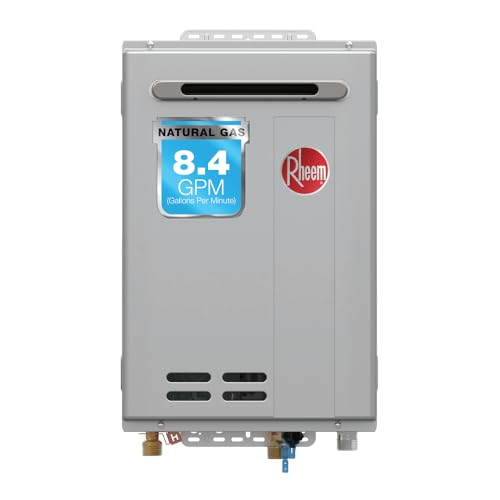
Whole house on natural gas: the certified 4.4 GPM
Rheem RTG-84XLN-3 (outdoor)
$964.10 · 4.4 GPM certified at a 67°F rise (box says 8.4) · UEF 0.82 · 180,000 BTU/hr · sold by Amazon.com
The largest certified flow among the units Amazon itself sells: 4.4 GPM at the 67°F test rise (only the third-party Rinnai certifies more, at 4.6), 180,000 BTU/hr, UEF 0.82, on the AHRI directory. Outdoor mount, so no vent kit and no vent-material bill. The "8.4 GPM" in the title is Rheem's own figure at a 35°F rise, which it states in the bullets; a northern winter is a 70°F rise, and the retailer copy of Rheem's sheet gives 4.3 GPM there.
Outdoor only; freeze protection is electric, so it needs power in winter. The indoor natural-gas version (RTG-70DVLN-3, 4.0 GPM certified) was on a ship-lead time on the build date. Low stock on 2026-09-19.
-

Whole house on propane, indoors: direct vent
Rheem RTG-70DVLP-3 (indoor)
$785.13 · 4.0 GPM certified at a 67°F rise (box says 7) · UEF 0.82 · 160,000 BTU/hr · sold by Amazon.com
4.0 GPM certified, 160,000 BTU/hr, UEF 0.82, direct-vent for an indoor wall, 15-year heat-exchanger warranty stated, sold by Amazon. The same certified capacity as its natural-gas sibling.
Direct vent means a listed vent kit and a wall penetration; budget for the vent kit Rheem's manual lists (this page read Rinnai's manual, not Rheem's). Its safety bullet still says "Natural Gas" although this is the propane SKU. Low stock on 2026-09-19.
-

Whole house on propane, outdoors, in stock
Rheem RTG-70XLP-3 (outdoor)
$770.17 · 4.0 GPM certified at a 67°F rise (box says 7) · UEF 0.82 · 160,000 BTU/hr · sold by Amazon.com
The same 4.0 GPM certified unit as above without the vent, in stock and sold by Amazon on 2026-09-19. The one to buy if the wall you have is an outside wall.
Same 7.0-at-35°F headline. The listing states built-in freeze protection, which is electric, so the unit needs power all winter, and a sheltered spot.
-
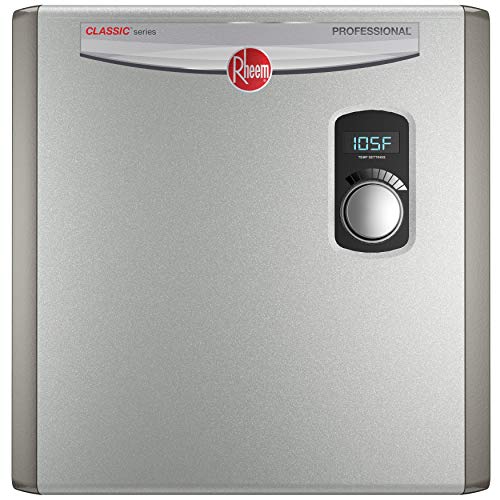
Whole house on electricity, in a mild climate with a 200 A panel
Rheem RTEX-24
$549.00 · 2.4 GPM certified at a 67°F rise (box says 5.9) · UEF 0.93 · 24 kW, 100 A at 240 V · sold by Amazon.com
The most capable electric unit on the directory in this set: 2.4 GPM certified at the 67°F rise, 4.7 GPM at a 35°F rise by the arithmetic, UEF 0.93, sold by Amazon. Its listing states the wiring honestly: three 40-amp double-pole breakers and a recommended minimum 200-amp service, and the retailer copies of Rheem's sheet say 100 A draw.
The box says "up to 5.9 GPM"; that is a 28°F rise by the arithmetic. In a northern winter (a 70°F rise) it is 2.3 GPM, one shower. If your panel is 100 or 150 A this unit does not fit, whatever the listing implies; that is the complaint the electricians in the harvested threads make.
-
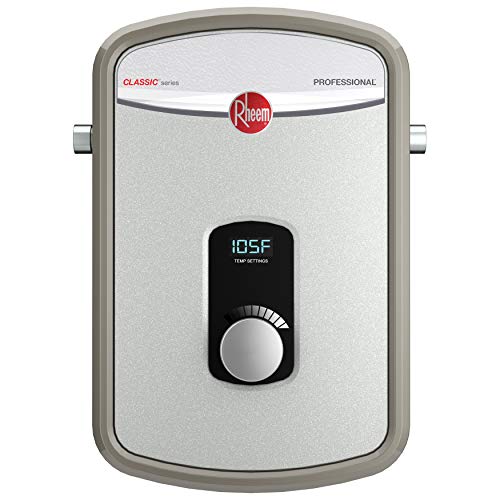
One fixture on electricity
Rheem RTEX-11
$249.00 · 1.2 GPM certified at a 67°F rise (box says 2.68) · UEF 0.92 · 11 kW, 46 A at 240 V · sold by Amazon.com
1.2 GPM certified, UEF 0.92, one 50-amp double-pole breaker per the listing, $249, sold by Amazon. A shower in the South or a sink anywhere; the certified figure is the honest size.
"Up to 2.68 GPM" on the box is a 28°F rise by the arithmetic. 11 kW at 240 V is 46 A; the listing's single 50 A breaker is 109% of that; Stiebel sizes its own units at 100% of load and footnotes that it treats a tankless heater as a non-continuous load. An electrician applying the 125% continuous-load margin would want 60 A.
-

Under a sink: point of use
Rheem RTEX-06T
$189.00 · 0.5 GPM certified at a 67°F rise · UEF 0.94 · 6.5 kW, 27 A at 240 V · sold by Amazon.com
0.5 GPM certified, UEF 0.94, thermostatic, $189, sold by Amazon. A hand-washing sink at the far end of the house, not a shower.
The listing states no GPM and no breaker size at all; 6.5 kW at 240 V is 27 A, so plan a 30 or 40 A double-pole circuit. The RTEX-04T ($186, 0.3 GPM) is the 120 V alternative for a single lavatory, hardwired on its own 30 A single-pole breaker.
The two Amazon-sold directory units not picked: Rheem RTEX-08 ($239, 0.7 GPM certified: the RTEX-11 certifies 1.2 for $10 more); Rheem RTEX-04T ($186, 0.3 GPM, 120 V: the RTEX-06T does 0.5 for $3.49 more, and the 04T is named in the point-of-use pick as the 120 V alternative). Fails the rule: Rheem RTG-70DVLN-3 (indoor natural gas, 4.0 GPM certified, on a ship-lead time on 2026-09-19). Not eligible: Rinnai RE199 (4.6 GPM certified, the most in the set, sold by eFaucets), Rheem RTEX-13 and RTEX-18 (sold by Miami Water Heater), Stiebel Eltron Tempra 24 (not in the AHRI corpus and prints no GPM at all), and the 27 units on no directory, 11 of them indoor or outdoor gas units that also state no safety listing. Amazon prices on 2026-09-19; they change. Affiliate links; we earn a commission at no cost to you.
09 / The three claims
"8.4 GPM", "no venting required" and "whole house", traced to their sources
Three phrases on the listings do most of the selling. Each has a document or a formula behind it; here is what it says.
- "8.4 GPM" (Rheem RTG-84)
- 4.4 certifiedthe listing states the 35°F rise; the directory certifies at 67°F 1
- "up to 5.9 GPM" (Rheem RTEX-24)
- 2.4 certifieda 28°F rise by the arithmetic; the listing does not state one 1
- "No venting required" (the electric listings)
- 60–120 Atrue, and the wiring is the vent: three 40 A breakers and a 200 A service for 24 kW 18
- "Whole house"
- 4.6 GPM maxthe largest certified flow in the set at 67°F; two winter showers is about 4 1
- Maker "8.4 GPM at 35°F temperature rise provides 180,000 BTU/hr output", from the Rheem RTG-84 listing. Honest as far as it goes; the retailer copy of Rheem's own sheet continues the table down to 4.5 GPM at a 67°F rise. 22
- Maker "24kW model provides up to 5.9 GPM", from the RTEX-24 listing, beside "three 40-amp double-pole breakers". The second half is the useful half. 1
- Testers "Whole-house tankless water heaters are designed to produce a target amount of hot water—typically 3 to 4 gallons a minute", and two electric units in the test could not hold 120°F from a 58°F inlet. 13
- Program ENERGY STAR asks 2.9 GPM at a 67°F rise and UEF 0.87 of a gas tankless unit; 0 of the 39 listings claim the mark, which is correct. 8
10 / Original research
39 Amazon bestsellers, checked against the AHRI directory
Creators API pull on 2026-09-19: "tankless water heater", "electric tankless water heater", "gas tankless water heater", "tankless water heater natural gas indoor", "point of use water heater", "tankless water heater propane". Match is by brand and model code (Rinnai's RE199 is filed under REU-VE2737FFD-US without the -N suffix Amazon adds). The physics columns divide the box's own kW or BTU figure (at the recovery efficiency AHRI certifies for the unit, 82% for an unlisted gas unit, 100% for an electric one) by 500 × rise; they are arithmetic, not certification. Flow claim, its stated rise, power, amperage, safety listing, minimum flow, venting and warranty were read by hand from each listing and carry the fragment they came from; a gate checks every fragment against the listing before deploy.
We took the top results for six Amazon searches, removed duplicates, and looked each brand and model up in the 993 Instantaneous rows of the AHRI directory held in the site corpus. The table is what the listing claims beside what the directory certifies, with the physics of the box's own power figure beside both, and the verbatim fragment behind every hand-read cell.
- AHRI listed
- 31%12 of 39 products
- Wi-Fi
- 15%6 of 39 products
- 12 of 39 are on the AHRI directory (Rheem, Rinnai); 27 are not, 17 of them gas or propane units.
- 11 of the 11 listed units that print a flow print 1.7 to 2.8 times the certified figure (median 2.1). 8 listings state a rise for their figure; 22 print a maximum or a bare number; the rest print no flow.
- Against the box's own power figure at the 67°F test rise, the printed flow runs 1.4 to 2.4 times the arithmetic (median 1.8) across the 29 listings that print both.
- 13 of the 17 electric units state an amperage or breaker; 4 of 39 state a minimum flow; 8 state a UEF; 0 claim ENERGY STAR.
- 24 of 39 state no safety listing; 9 state CSA, 5 ETL, 1 UL. 11 indoor or outdoor gas units state neither a safety mark nor appear on the directory.
- 14 of 39 are sold by Amazon itself, 25 by third parties; 6 were on a lead time, scarce or unavailable on 2026-09-19. Prices run $55.98 to $1,280.79.
| Product | Brand | Model | Price | Sold by | Kind | Fuel | GPM on the box | Rise on the box | GPM certified | Box ÷ certified | GPM at 67°F (arithmetic) | UEF (certified) | kW | BTU/hr | Amps at 240 V | Amps/breaker on the box | Safety mark stated |
|---|---|---|---|---|---|---|---|---|---|---|---|---|---|---|---|---|---|
| 110V Tankless Water Heater Electric | xwdzswgs | Tankless Water Heater | $55.98 | liuyiliang7788 | point-of-use electric | electric | 0.5 | rise stated | — | — | 0.31 | — | 3 | — | 12 | 32 | ETL |
| Rheem RTEX-11 | Rheem | RTEX-11 | $249.00 | Amazon.com | whole-house electric | electric | 2.68 | max or unstated | 1.2 | 2.23 | 1.12 | 0.92 | 11 | — | 46 | 50 | none stated |
| Rheem RTEX-18 | Rheem | RTEX-18 | $438.00 | Miami Water Heater | whole-house electric | electric | 4.4 | max or unstated | 1.7 | 2.59 | 1.83 | 0.94 | 18 | — | 75 | — | none stated |
| SIVUATEK TSB-140 | SIVUATEK | TSB-140 | $208.99 | SIVUATEK-US | whole-house electric | electric | — | not applicable | — | — | 1.43 | — | 14 | — | 58 | 60 | none stated |
| Orbek 14kW 2.0 Model | Orbek | 14kW 2.0 Model | $199.99 | Westinghouse Home Comfort Direct | whole-house electric | electric | 3.38 | max or unstated | — | — | 1.43 | — | 14 | — | 58 | 60 | ETL |
| Baococo YYJ24046-18 | Baococo | YYJ24046-18 | $150.93 | Amazon.com | portable propane | propane | 4.76 | max or unstated | — | — | 2.83 | — | — | 115425 | — | — | none stated |
| CAMPLUX ENJOY OUTDOOR LIFE AY132 | CAMPLUX ENJOY OUTDOOR LIFE | AY132 | $151.99 | Camplux | portable propane | propane | 1.32 | max or unstated | — | — | — | — | — | — | — | — | CSA |
| Rheem RTEX-13 | Rheem | RTEX-13 | $279.00 | Miami Water Heater | whole-house electric | electric | 3.17 | max or unstated | 1.3 | 2.44 | 1.32 | 0.88 | 13 | — | 54 | 54 | none stated |
| Westinghouse 14kW Tankless Water Heater Electric 240V | Westinghouse | — | $299.99 | Westinghouse Home Comfort Direct | whole-house electric | electric | 3.4 | rise stated | — | — | 1.43 | — | 14 | — | 58 | 60 | ETL |
| Rheem RTEX-24 | Rheem | RTEX-24 | $549.00 | Amazon.com | whole-house electric | electric | 5.9 | max or unstated | 2.4 | 2.46 | 2.44 | 0.93 | 24 | — | 100 | 120 | none stated |
| Rheem RTEX-08 | Rheem | RTEX-08 | $239.00 | Amazon.com | whole-house electric | electric | 1.95 | max or unstated | 0.7 | 2.79 | 0.81 | 0.96 | 8 | — | 33 | 40 | none stated |
| Stiebel Eltron 24 Trend | Stiebel Eltron | 24 Trend | $519.23 | Amazon.com | whole-house electric | electric | — | not applicable | — | — | 2.44 | — | 24 | — | 100 | 150 | none stated |
| WINTEMP WN18 | WINTEMP | WN18 | $279.98 | WINTEMP | whole-house electric | electric | 4.3 | max or unstated | — | — | 1.83 | — | 18 | — | 75 | 80 | ETL |
| Rheem RTG-70DVLN-3 | Rheem | RTG-70DVLN-3 | $653.77 | Amazon.com | gas indoor | natural gas | 7 | rise stated | 4 | 1.75 | 4.01 | 0.82 | — | 160000 | — | — | CSA |
| thermomate CZ422NG | thermomate | CZ422NG | $341.99 | ThermoMate Official | gas indoor | natural gas | 5 | rise stated | — | — | 2.77 | — | — | 113000 | — | — | CSA |
| Ranein RH19K-NG | Ranein | RH19K-NG | $699.00 | Ranein Store | gas indoor | natural gas | 8.5 | max or unstated | — | — | 4.65 | — | — | 190000 | — | — | none stated |
| Rheem RTG-84XLN-3 | Rheem | RTG-84XLN-3 | $964.10 | Amazon.com | gas outdoor | natural gas | 8.4 | rise stated | 4.4 | 1.91 | 4.57 | 0.82 | — | 180000 | — | — | CSA |
| MIZUDO FDG-CS120AW-NG | MIZUDO | FDG-CS120AW-NG | $483.55 | Mizudo Home Comfort Direct | gas outdoor | natural gas | 5.1 | max or unstated | — | — | 2.94 | — | — | 120000 | — | — | CSA |
| NOVIEEX RS-16 | NOVIEEX | RS-16 | $269.99 | NOVIEEX Global | gas indoor | propane | 4.3 | max or unstated | — | — | 2.45 | — | — | 100000 | — | — | none stated |
| APUS AP-AWH-Q13NG | APUS | AP-AWH-Q13NG | $299.99 | APUS WATER EQUIPMENT | gas indoor | natural gas | 4.42 | max or unstated | — | — | 2.33 | — | — | 95000 | — | — | none stated |
| VEVOR JSQ30-A | VEVOR | JSQ30-A | $141.64 | Amazon.com | gas indoor | natural gas | — | not applicable | — | — | 2.45 | — | — | 100000 | — | — | none stated |
| MIZUDO WCIU-HW199A1G-NG-M0 | MIZUDO | WCIU-HW199A1G-NG-M0 | $949.99 | Mizudo Home Comfort Direct | gas indoor | natural gas | 10.3 | max or unstated | — | — | 4.87 | — | — | 199000 | — | — | CSA |
| Ranein RH19K-LPG | Ranein | RH19K-LPG | $699.00 | Ranein Store | gas indoor | propane | 8.5 | max or unstated | — | — | 4.65 | — | — | 190000 | — | — | none stated |
| GASLAND CE686NG | GASLAND | CE686NG | $629.99 | Gasland | gas indoor | natural gas | 7.6 | max or unstated | — | — | 4.87 | — | — | 199000 | — | — | CSA |
| Westinghouse HW180A0G-NG | Westinghouse | HW180A0G-NG | $799.92 | Westinghouse Home Comfort Direct | gas indoor | natural gas | 7.9 | max or unstated | — | — | 4.41 | — | — | 180000 | — | — | none stated |
| APUS AP-AWH-Q20NG | APUS | AP-AWH-Q20NG | $499.99 | APUS WATER EQUIPMENT | gas indoor | natural gas | 6.8 | max or unstated | — | — | 3.43 | — | — | 140000 | — | — | none stated |
| Rinnai REU-VE2737FFD-US-N | Rinnai | REU-VE2737FFD-US-N | $1280.79 | eFaucets | gas indoor | natural gas | 9.8 | max or unstated | 4.6 | 2.13 | 4.93 | 0.82 | — | 199000 | — | — | none stated |
| Rheem RTEX-06T | Rheem | RTEX-06T | $189.00 | Amazon.com | point-of-use electric | electric | — | not applicable | 0.5 | — | 0.66 | 0.94 | 6.5 | — | 27 | — | none stated |
| thermomate ES | thermomate | ES | $189.99 | ThermoMate Official | mini-tank electric | electric | — | not applicable | — | — | 0.15 | — | 1.44 | — | 6 | 12 | UL |
| GE GE02P08BAW | GE | GE02P08BAW | $239.00 | Amazon.com | mini-tank electric | electric | — | not applicable | — | — | — | — | — | — | — | — | none stated |
| LECLOC C3000 | LECLOC | C3000 | $179.99 | LECLOC | point-of-use electric | electric | — | not applicable | — | — | 0.31 | — | 3 | — | 12 | — | none stated |
| Rheem RTEX-04T | Rheem | RTEX-04T | $185.51 | Amazon.com | point-of-use electric | electric | 0.5 | max or unstated | 0.3 | 1.67 | 0.36 | 0.95 | 3.5 | — | 15 | 30 | none stated |
| thermomate ET060 | thermomate | ET060 | $149.99 | ThermoMate Official | point-of-use electric | electric | 1 | rise stated | — | — | 0.61 | — | 6 | — | 25 | 30 | ETL |
| Rheem RTG-70XLP-3 | Rheem | RTG-70XLP-3 | $770.17 | Amazon.com | gas outdoor | propane | 7 | rise stated | 4 | 1.75 | 4.01 | 0.82 | — | 160000 | — | — | CSA |
| Ranein RH8K-LPG-FC-RATING | Ranein | RH8K-LPG-FC-RATING | $299.00 | Ranein Store | gas indoor | propane | 3.6 | max or unstated | — | — | 1.96 | — | — | 80000 | — | — | none stated |
| VEVOR JSQ30-B | VEVOR | JSQ30-B | $169.90 | Amazon.com | gas indoor | propane | — | not applicable | — | — | 2.45 | — | — | 100000 | — | — | none stated |
| VEVOR JSW38-20L-B | VEVOR | JSW38-20L-B | $280.46 | VEMIXO | gas outdoor | propane | — | not applicable | — | — | 2.94 | — | — | 120000 | — | — | none stated |
| Ranein RANEIN-43GPM-100KBTU | Ranein | RANEIN-43GPM-100KBTU | $399.00 | Ranein Store | gas indoor | propane | 4.3 | max or unstated | — | — | 2.45 | — | — | 100000 | — | — | none stated |
| Rheem RTG-70DVLP-3 | Rheem | RTG-70DVLP-3 | $785.13 | Amazon.com | gas indoor | propane | 7 | rise stated | 4 | 1.75 | 4.01 | 0.82 | — | 160000 | — | — | CSA |
Certified figures are the AHRI directory's. GPM on the box = the figure the listing leads with; "rise on the box" = the condition it attaches, if any. Box ÷ certified = the ratio. GPM at 67°F (arithmetic) = the box's own power ÷ (500 × 67). Amps at 240 V = kW × 1000 ÷ 240. Electric units are taken at 100% conversion, unlisted gas units at 82%. Verbatim fragments, venting, warranty, minimum flow and the 35°F and 70°F arithmetic are in the CSV download. Prices, sellers and stock are Amazon's on the build date.
This table is not offered as a download. It is built from Amazon listings and other sources we may not republish, so we show it on this page only.
11 / The consensus
What 29 sources say about tankless water heaters, and where they split
3 Regulator pages · 3 Measured tests · 1 Standard · 3 Certification documents · 2 Guidelines · 3 Editorial guides · 5 Maker pages · 2 Trade pages · 2 Utility rebates · 5 Recall notices
The test procedure and the standards it feeds, DOE and ENERGY STAR, AHRI, the field study and a Building America profile, Consumer Reports, three editorial guides with named authors, one trade article, four maker spec sheets, one maker's electrical chart and one install manual, two utility rebates, four recall notices and the site's own installed-cost and recall records, in one table. The sizing stance each takes is plotted in the findings above.
| Source | Who | Recommends | Their bottom line |
|---|---|---|---|
| DOE — Tankless or Demand-Type Water Heaters Regulator page · current consumer page; content confirmed via 3 independent WebSearch queries 2026-09-19 (direct WebFetch returned HTTP 404 across 5 URL variants this session) | U.S. Department of Energy (no byline) | States gas-fired tankless units produce higher flow rates than electric ones and that typical output runs '2–5 gallons per minute,' with the largest gas model sometimes unable to cover simultaneous … · Not this page's focus; no gas-line, venting, or amperage detail in the fetched text. | The government's own headline efficiency number is not a flat percentage — it is a sliding scale that roughly halves (24–34% down to 8–14%) as a household's daily hot-water use rises from 41 to 86 gallons, because standby-loss avoidance is worth more the less a storage tank would otherwise be used. |
| DOE Building America — Tankless Gas Water Heater Performance (Top Innovations Hall of Fame Measured test · PNNL-SA-90582, January 2013; document read directly 2026-09-19 | U.S. Department of Energy Building America Program / National Renewable Energy Laboratory | Not this document's focus (n=2 field comparison of a 0.60-EF storage unit against a 0.82-EF tankless unit); no GPM data reported. · Not this document's focus. | Tankless efficiency is not a fixed number you get by multiplying EF — it is measured to actually approach the rated Energy Factor only on long draws (10+ gallons), and net household savings peak at a specific, moderate daily-use level (about 50 gal/day) rather than scaling linearly with more hot water use. |
| 10 CFR Part 430, Subpart B, Appendix E — Uniform Test Method for Measuring the Energy Cons Standard · current text (UEF basis) plus its own Appendix A (legacy EF basis, revised as of January 1, 2014); fetched 2026-09-19 | U.S. Department of Energy / Office of the Federal Register | Defines the certified 'Maximum GPM Rating' TWICE, at two different rises, depending which certification pathway a model uses: the current UEF pathway's Maximum GPM Rating is set at a 58°F±2°F supply … · Not an installation document. | The '77°F rise' figure most buying-guide readers assume is universal is the OLDER of two federally defined test rises still both in active use — the newer, current UEF pathway actually certifies Max GPM at a 67°F rise (125°F out, not 135°F), so a box's certified GPM number can legitimately be measured at either rise depending on which pathway the manufacturer certified under. |
| 10 CFR § 430.32(d) — Energy conservation standards for water heaters (eCFR, via Cornell LI Regulator page · current text (Table 13, products manufactured before May 6, 2029); fetched 2026-09-19 | U.S. Department of Energy | Not a flow-rate document; sets the minimum efficiency floor, not the flow-rate floor, for instantaneous units. · Not an installation document. | The federal MINIMUM efficiency floor for a gas tankless unit (UEF 0.80–0.81) sits well below the ENERGY STAR voluntary bar (UEF ≥ 0.87) — a no-name unit can be 100% legal to sell in the US while still 6–8 UEF points short of qualifying for any ENERGY STAR-gated utility rebate. |
| 10 CFR § 429.12(a) — Certification of compliance (eCFR, via Cornell LII mirror) Regulator page · current text; fetched 2026-09-19 | U.S. Department of Energy | Not applicable. · Not an installation document. | This is the actual legal gate — a DOE CCMS certification filing, not an AHRI listing and not a UL/CSA/ETL safety mark — that a manufacturer must clear before a water heater model may be sold in the US at all. |
| ENERGY STAR — Program Requirements Product Specification for Residential Water Heaters, El Certification document · effective April 16, 2015 (Section 6, Effective Date); PDF header reads 'Version 3.3 Draft 2' but its own effective-date text and thresholds match the currently-cited spec; document read directly 2026-09-19 | U.S. EPA / ENERGY STAR (no byline) | Certified Max GPM for gas-fired instantaneous units (UEF pathway, Table 3): 'Max GPM ≥ 2.9 over a 67°F rise.' A separate, legacy EF pathway (Appendix A, Table 3) requires 'GPM ≥ 2.5 over a 77°F rise' … · Not an installation document; requires safety compliance to ANSI Z21.10.3/CSA 4.3, the same gas-appliance safety standard referenced on … | The current ENERGY STAR gas-tankless bar is a single number — UEF ≥ 0.87 and Max GPM ≥ 2.9 at a 67°F rise — with no separate, lower bar for non-condensing units; a non-condensing unit that can't clear 0.87 simply doesn't certify, regardless of its GPM rating. |
| ENERGY STAR — Water Heaters Key Product Criteria Certification document · current; page fetched 2026-09-19 | U.S. EPA / ENERGY STAR (no byline) | Not independently confirmed with a fresh verbatim quote from this specific URL this session (redundant with the full V3.3 spec PDF, ESTAR:V33SPEC row above, which was read directly). · Not an installation page. | This page is the public-facing pointer to the V3.3 spec's actual numeric tables — useful as the canonical URL utilities cite (see PSEG:REBATE, SOCALGAS:REBATE rows), but the load-bearing numbers themselves were confirmed against the underlying spec PDF, not this landing page. |
| ENERGY STAR — Whole Home Tankless Gas Water Heaters Guideline · current; page fetched 2026-09-19 | U.S. EPA / ENERGY STAR (no byline) | Not this page's focus; it links out to the ENERGY STAR Product List filterable by 'uniform_energy_factor_uef' rather than restating flow numbers itself. · Notes these units are 'currently available from contractors and retailers,' implying professional installation is the expected path, … | ENERGY STAR's own consumer-facing product page markets the 'heat only when needed' + 'continuous hot water' pitch without restating its own numeric efficiency bar, leaning on the linked directory instead. |
| AHRI — Residential Water Heaters (RWH) certification program Certification document · current; page fetched 2026-09-19 | Air-Conditioning, Heating, and Refrigeration Institute (no byline) | States the program independently verifies output measurements, specifically 'First Hour Rating for storage units or Maximum GPM for instantaneous units.' · Not an installation document. | AHRI listing is a THIRD-PARTY VERIFICATION layer on top of a manufacturer's own DOE-required self-certification (DOE:42912A row) — useful because it's independently checked, but its own page never claims that a manufacturer must be AHRI-listed to legally sell a unit in the US, which is a materially different (and stronger) claim than 'AHRI-listed = compliant.' |
| Center for Energy and Environment — Actual Savings and Performance of Natural Gas Tankless Measured test · August 30, 2010; prepared for the Minnesota Office of Energy Security; document read directly 2026-09-19 | Dave Bohac, Ben Schoenbauer, Martha Hewett, Mary Sue Lobenstein, Tom Butcher, Center for Energy and Environment (Bohac, Schoenbauer, Hewett), Lobenstein Consulting (Lobenstein), Brookhaven | Cites AHRI's own 2010 directory: residential TWHs 'have minimum inputs ranging from 11,000 to 20,000 Btu/hr and maximum inputs ranging from 117,000 to 199,900 Btu/hr,' with 'flow rates at a 77°F … · Local contractors' installed-cost estimates: $2,000–$5,000, typical $2,500–$3,400, driven by 'side wall venting' with 'expensive venting … | The only independently-metered, multi-site field study in this panel: real tankless units in real Minnesota homes saved 37% on average, but delivered that saving from a draw pattern (32 short draws/day averaging 1.2 gallons) nothing like the federal test's six 10+-gallon draws, and the minimum flow to fire the burner (about 0.5 GPM) measurably suppressed the smallest draws homeowners used to take before switching. |
| Consumer Reports — Tankless Water Heaters vs. Storage Tank Water Heaters Measured test · January 25, 2019; fetched 2026-09-19 | Mary H.J. Farrell, writer, Consumer Reports (quoting CR engineer John Banta and plumber Geno Caccia) | 'Whole-house tankless water heaters are designed to produce a target amount of hot water—typically 3 to 4 gallons a minute.' Notes two electric tankless models (Bosch, Rheem) in CR's tests failed to … · Installed cost: storage tank $600–$800 vs. tankless $800–$1,500 (gas), 'may require gas line upgrades and 200-amp electrical service … | CR's own payback math argues against replacing a working storage heater with tankless purely for savings — John Banta: 'If you have a warranty of 12 to 15 years, which is typical, it doesn't make financial sense to replace a tank water heater with a tankless,' given CR's 22.5–27.5-year gas-tankless payback estimate. |
| Bob Vila — The Best Tankless Water Heaters of 2026 Editorial guide · December 30, 2025; fetched 2026-09-19 | Timothy Dale, writer, Bob Vila | Household sizing rule: '1 to 3 occupants require 3- to 5-GPM water heaters. Larger households with four or more people may need a model capable of providing 8 to 9 GPM.' · 'Many homes—especially older ones—may require an electrical panel upgrade to meet the high amperage demands' of electric models; … | The clearest plain-language statement in this panel of the BTU-input formula that ultimately explains why the same physical unit's 'GPM' number changes with the temperature rise assumed — more rise per gallon needs more BTU/hr input to hold the same flow rate. |
| Family Handyman — 7 Best Water Heater Brands of 2026, Our Expert Picks & Reviews Editorial guide · updated March 13, 2026; fetched 2026-09-19 | Mary Henn (updated by Emily Way), writer, Family Handyman | Cites the Rheem gas tankless model as able to 'supply about seven gallons a minute, providing hot water for the whole house.' · Its named electric whole-house pick needs a serious panel: 'Generating that much heat requires a significant amount of space in the … | A concrete, named-model illustration of the electric-panel story: a single whole-house electric tankless unit can require FOUR 40-amp double-pole breakers (160 A of breaker capacity) — more than the 3×40A seen on the smaller RTEX-24/ECO-27-class units in this panel, underscoring that panel-capacity risk scales with the specific model chosen, not a flat rule. |
| This Old House — The 5 Best Tankless Water Heaters (2026) Editorial guide · June 15, 2026; fetched 2026-09-19 | Alexis Carthan, writer, This Old House | Per-fixture flow budget: 'A shower may require about 2.5 GPM, a dishwasher about 1 GPM, a washing machine about 1.5 GPM, and a kitchen faucet about 0.5 GPM.' · Electric point-of-use models: the Rheem model checked 'requires a dedicated 40-amp circuit breaker.' Gas models: 'Gas-powered tankless … | One of the few consumer sources in this panel to break sizing down fixture-by-fixture (shower 2.5 GPM, dishwasher 1 GPM, washer 1.5 GPM, kitchen faucet 0.5 GPM) rather than by household headcount — useful for readers stacking simultaneous uses rather than just counting bathrooms. |
| Stiebel Eltron — Tempra & Tempra Plus Technical Specifications Maker page · current spec sheet; document read directly 2026-09-19 | manufacturer | Full temperature-rise-vs-flow-rate chart at both 240V and 208V for the whole Tempra line; for the Tempra 24/24 Plus at 240V: maximum temperature rise of 92°F at 1.50 GPM, 73°F at 2.25 GPM, 54°F at … · Tempra 24/24 Plus at 240V: 24 kW, amperage draw '2 x 50 A,' recommended breakers '2 x 50 A' (double-pole), wire '2 x 6/2 AWG' copper, … | The clearest manufacturer-published proof in this panel that the SAME physical electric tankless unit changes its own amperage draw, kW output, and even its safe maximum flow-at-rise numbers depending on whether it's wired to 240V or 208V service — 24 kW/2×50A at 240V becomes 18 kW/2×44A at 208V for the identical Tempra 24/24 Plus hardware. |
| Rheem — Professional Classic RTEX Tankless Electric Water Heater spec sheet (RTEX-24) Maker page · form TKE-101 Rev. 9, 06/24; content confirmed via WebSearch snippet 2026-09-19 (direct WebFetch of this PDF returned unreadable binary content) | manufacturer | Rated 4.68 GPM (retailer copies say at a 45°F rise; 24 kW × 3412 ÷ (500 × 4.68) puts that at a 35°F rise), with a stated 7 GPM maximum and 0.3 GPM minimum flow per third-party retailer listings … · 24 kW at 240V; maximum draw 100 A; requires THREE 40 A double-pole circuit breakers; recommended minimum 200 A household electrical … | The RTEX-24's own spec sheet is the panel's clearest single data point for the '18 kW at 240V = 75A, two 40A breakers; 24 kW = 100A, three' math the page's thesis leads with: 24 kW really does draw 100 A and really does need three 40A double-pole breakers on a 200A-minimum service, matching the physics exactly. |
| EcoSmart — ECO 27 Electrical Requirements Maker page · current; page fetched 2026-09-19 | manufacturer | Not this page's focus (a dedicated electrical-requirements chart, not a flow/rise chart). · For the ECO 27 model specifically: amperage '112.5 Amps,' breaker 'three dedicated 40-amp double-pole circuit breakers in the main … | EcoSmart's own electrical-requirements chart for the ECO 27 (112.5 A, 3×40A breakers, 3×#8 AWG) matches an independent engineer's write-up of the same model almost exactly (ENGINEERFIX:ECO27 row below), which is the strongest possible corroboration available in this panel for a manufacturer-published amperage figure. |
| Engineer Fix — EcoSmart ECO 27: Sizing, Electrical, and Maintenance Trade page · 2026; fetched 2026-09-19 | Liam Cope, founder, Engineer Fix (electrical and mechanical engineer; six years of training including an advanced apprent | Not this article's central focus beyond the electrical specs below (a sizing/electrical/maintenance piece, not a flow-rate chart). · Independently states 'maximum amperage of 112.5 amps at 240 volts,' 'three dedicated 40-amp double-pole circuit breakers in the main … | A named, credentialed electrical engineer's independent write-up of the ECO 27 reproduces the manufacturer's own 112.5A / 3×40A / 8 AWG figures exactly, which is the closest this panel gets to independent third-party verification of a specific electric tankless model's amperage claim. |
| Rinnai — V65i (VC2025FFU-US) Spec Sheet and Flow Table Maker page · V65i SP(03), 6/2018; document read directly 2026-09-19 | manufacturer | Flow table plotted across delta-T from 0 to 150°F: holds a flat maximum of 6.5 GPM (24.6 L/min) from 0 up to roughly 25°F rise, then falls in a smooth curve to about 2 GPM at 125°F rise. Minimum … · Service connections: 'Gas supply: 3/4 inch MNPT; Cold water inlet: 3/4 inch MNPT; Hot water outlet: 3/4 inch MNPT.' Natural gas supply … | A budget-tier ('Value Series') Rinnai model is certified at exactly the federal UEF floor (0.80) rather than the ENERGY STAR bar (0.87) — legal to sell, but a full 7 points short of qualifying for any of the utility rebates in this panel, and its 6.5 GPM max flow drops to about 2 GPM by the time delta-T reaches 125°F, a realistic winter rise in a cold-climate market. |
| Rheem — RTG Series High Efficiency Tankless Gas Water Heaters spec sheet (RTG-84) Maker page · form TK-RTG SERIES REV. 1, 07/23; content confirmed via WebSearch snippet 2026-09-19 (a second direct WebFetch attempt on a different revision of this PDF returned HTTP 404) | manufacturer | Flow-vs-rise chart per third-party retailer/search-indexed spec data: 8.4 GPM max (35°F rise), 7.8 GPM at 40°F rise, 6.7 GPM at 45°F rise, 6.1 GPM at 50°F rise, 5.1 GPM at 60°F rise, 4.5 GPM at 67°F … · Not independently confirmed this session (PDF not directly rendered). | The RTG-84's own box-headline '8.4 GPM' is only true at a 35°F rise — by the time delta-T reaches 67°F (the current UEF Max-GPM test basis, per the DOE Appendix E row above), the same physical unit is rated at 4.5 GPM, just over half its headline number, closely matching the brief's own worked example for the sibling RTG-70/RTG-84 pair. |
| Rinnai — Direct Vent Tankless Water Heater Installation and Operation Manual (Value Series Trade page · U307-1120X03(01) / 100000258(09), 5/2019; document read directly 2026-09-19 | manufacturer installation manual, for use by 'a licensed professional' | Not this manual's focus (an installation document); its own spec table (V65i/V75i/V94Xi/V94i) restates the same hot-water-capacity ranges as the standalone V65i spec sheet row above. · Venting: 'Do not use PVC, CPVC, ABS or galvanized material to vent this appliance'; 'this water heater is a direct vent water heater and … | This is the trade-level ground truth behind the page's 'Category III venting' framing: Rinnai's own manual doesn't use that exact term, but its rule is functionally the same — no PVC/CPVC/ABS/galvanized, sealed direct-vent components from a short manufacturer-listed set only, because the exhaust runs hot and (in a condensing unit) wet enough to corrode ordinary materials. |
| PSE&G — Tankless Water Heaters rebate program Utility rebate · current program; page fetched 2026-09-19 | PSE&G (Public Service Enterprise Group, New Jersey investor-owned utility) | No specific GPM requirement stated. · Not this page's focus beyond the rebate mechanics. | A flat $500 post-purchase rebate gated on exactly the ENERGY STAR 0.87 UEF threshold, no separate condensing/non-condensing tier — the same single bar ENERGY STAR itself uses. |
| SoCalGas — ENERGY STAR Certified Natural Gas Water Heaters rebate flyer Utility rebate · © 2023 Southern California Gas Company; document read directly 2026-09-19 | Southern California Gas Company (administered under the California Public Utilities Commission) | No specific GPM requirement stated. · 'Must be replacing a conventional storage water heater. Limit one per household.' Notes 'up to $600 Federal Tax credit may be available for … | A three-tier rebate that pays MORE for a higher UEF ($1,000 at ≥0.95, condensing-territory) than for a merely ENERGY STAR-qualifying unit ($800 at 0.87–0.94) or a sub-ENERGY-STAR 'high-efficiency' unit ($80 at 0.82–0.86) — the only utility in this panel to reward condensing efficiency specifically rather than a flat ENERGY STAR pass/fail. |
| CPSC — Tankless Water Heaters Recalled for Repair Due to Carbon Monoxide Poisoning Hazard Recall notice · February 21, 2007; fetched 2026-09-19 | U.S. Consumer Product Safety Commission | n/a · n/a | A component-shift-in-transit defect (an air filter door switch) on about 42,200 Paloma/Rheem/Ruud/Rheem-Ruud/Richmond-brand tankless units — the earliest tankless-specific CO recall located in this panel, and a reminder that CO risk on a sealed direct-vent unit can originate from an internal safety-interlock defect, not just a venting-installation error. |
| CPSC — Navien Recalls Tankless Water Heaters and Boilers Due to Risk of Carbon Monoxide Po Recall notice · December 20, 2018; matched to the VerifiedHVACData corpus per LOCAL:CPSC | U.S. Consumer Product Safety Commission | n/a · n/a | About 3,400 Navien-brand tankless water heaters and boilers recalled for a carbon monoxide poisoning risk — a relatively small unit count compared to the storage-heater recalls elsewhere in this corpus, but notable because Navien is a market-leading condensing-tankless brand cited approvingly for its buffer-tank design in the CEE:BOHAC2010 field study. |
| CPSC — VESTA.DS Recalls VST Brand Tankless Water Heaters Due to Carbon Monoxide (CO) Poiso Recall notice · October 16, 2025 (about 36,700 units in the US, plus about 3,500 in Canada); matched to the VerifiedHVACData corpus per LOCAL:CPSC | U.S. Consumer Product Safety Commission | n/a · n/a | The most recent and largest CO-specific tankless recall in this panel: 36,700+ VST-brand units recalled for cracked exhaust ducts letting fumes leak into the home, sold May 2017 through July 2025 — a physical duct-integrity failure mode, distinct from the 2007 Paloma recall's internal switch defect and a reminder that venting failure risk isn't limited to installation error. |
| CPSC — The Home Appliances Recalls Camplux Brand Portable Tankless Water Heaters Due to Fi Recall notice · February 29, 2024; located via WebSearch, title confirmed 2026-09-19 | U.S. Consumer Product Safety Commission | n/a · n/a | About 42,000 Camplux-brand PORTABLE tankless water heaters recalled for a fire hazard — the panel's one recall on the small, off-grid/RV-class portable segment rather than a whole-house residential unit, worth flagging as a different product category from every other model discussed on this page. |
| VerifiedHVACData internal — installed_prices_water_heaters.json (gas tankless replacement Guideline · compiled 2026-07-18; cited as-is 2026-09-19 | VerifiedHVACData research corpus (compiled from HomeAdvisor, Fixr, Bob Vila, Angi, HomeGuide, pieceofmindplumb | n/a · Gas tankless REPLACEMENT (venting/gas line already correctly sized): $1,400–$4,000, typical $2,527. Gas tankless CONVERSION from an … | The single most commonly conflated cost story in tankless shopping, made explicit: swapping an existing tankless unit for a new one ($1,400–$4,000) costs materially less than converting FROM a storage tank ($2,100–$8,000), almost entirely because of gas-line upsizing and venting changes, not the unit price itself. |
| VerifiedHVACData internal — water_heater_cpsc.json (SaferProducts.gov recall pull, brand-m Recall notice · pulled 2026-07-19; cited as-is 2026-09-19 | VerifiedHVACData research corpus (pulled from cpsc.gov's public /Recall REST API) | n/a · n/a | Of the 8 corpus brands with a matched CPSC water-heater recall in the last decade, only NAVIEN and VESTA's recalls are tankless-specific; the A. O. Smith, American, American Standard, Giant, Rheem, and State entries in this same file are for STORAGE or component-supplier issues (e.g. 'A. O. Smith Recalls Ultra-Low NOx Water Heaters,' 'Usines Giant Factories Recalls Gas Water Heaters with Emerson Control Valves') and should not be presented as tankless recalls on this page. |
Where they agree
- Flow depends on rise. The test procedure, both spec sheets that print a curve, Bob Vila's formula and the field study say it; the listings that print one point at 35°F are stating the same physics from the flattering end.
- Electric whole-house units are a panel decision. Rheem, Stiebel, EcoSmart, Family Handyman, Bob Vila and This Old House all put the breaker count first.
- Gas conversions cost more than replacements, for the line and the vent. The field study's contractors, Consumer Reports, Bob Vila and the site's reconciled cost guides agree on the reason and roughly on the range.
- Venting is the hazard. Rinnai's non-condensing manual bans plastic vent material, and three of the four recalls were carbon-monoxide hazards.
Where they split
- How much does it save? — DOE's consumer page: 24 to 34% for a low-use home, 8 to 14% for a high-use one. Building America: a 0.8 energy factor "suggests" 33% against a 0.6 tank. The field study: 37% measured, but at a 20-to-40-year payback, with measured efficiency averaging 16% less than the rating across all units. Consumer Reports: $195 against $245 a year. The measured number is close to DOE's upper claim and the money is small either way: about $50 a year at Consumer Reports' prices, against a conversion that costs thousands. Buy it for endless hot water and floor space; the bill is a rounding error next to the install.
- How do you size one? — Bob Vila and This Old House: add up the fixtures (a shower 2.5 GPM, a dishwasher 1, a washer 1.5) or count occupants (1–3 people, 3–5 GPM; four or more, 8–9). DOE and Consumer Reports: do not expect simultaneous uses from even the largest gas unit. The spec sheets: read the flow at your rise. The household rules assume a summer rise. At the 67°F test rise the largest gas unit here certifies 4.6 GPM and the largest electric 2.4, so "8 to 9 GPM for four people" is a number no unit in this set delivers in winter anywhere north of the Gulf. Size on rise first, then count fixtures.
- Is electric tankless a whole-house heater? — The listings: "whole house", "up to 5.9 GPM", "no venting required". Family Handyman: dedicate four 40-amp breakers. Consumer Reports' engineer: more efficient and more expensive to run. The community: it took a panel upgrade. In a mild climate with a 200 A service, a 24 kW unit runs two showers at a 35°F rise. In a cold one it runs one, at about $779 a year on the site's formula against $269 for the gas RTG-84 on the same draws. Whole-house is a climate and a panel, not a product class.
Who is cited
Who is cited on this page
Named people with a verifiable published position, fetched directly on the build date. Quotes are verbatim from the linked page. No one listed reviewed this page. Wirecutter (nytimes.com blocked at the tool level) and The Spruce (no locatable dedicated tankless-water-heater URL across 3 differently-worded searches) could not be fetched, so no bylines from those outlets appear here; the attempts are recorded in the consensus panel's failed_sources.
- Mary H.J. Farrell writer, Consumer Reports
Whole-house tankless water heaters are designed to produce a target amount of hot water—typically 3 to 4 gallons a minute.
Consumer Reports, "Tankless Water Heaters vs. Storage Tank Water Heaters" · 2019-01-25 ↗ - John Banta engineer, Consumer Reports (quoted within Mary H.J. Farrell's article)
Electric models actually run more efficiently, but the higher cost of electricity makes them more costly to operate.
Consumer Reports, "Tankless Water Heaters vs. Storage Tank Water Heaters" · 2019-01-25 ↗ - Geno Caccia third-generation plumber (quoted within Mary H.J. Farrell's Consumer Reports article)
When you make a change like that, the house operates a little differently.
Consumer Reports, "Tankless Water Heaters vs. Storage Tank Water Heaters" · 2019-01-25 ↗ - Timothy Dale writer, Bob Vila
500 x GPM x Temperature Rise = Required Power Input in BTU per Hour
Bob Vila, "The Best Tankless Water Heaters of 2026" · 2025-12-30 ↗ - Mary Henn writer, Family Handyman (updated by Emily Way)
Generating that much heat requires a significant amount of space in the electrical breaker box—you'll need to dedicate four 40-amp double-pole breakers to this heater.
Family Handyman, "7 Best Water Heater Brands of 2026, Our Expert Picks & Reviews" · 2026-03-13 ↗ - Alexis Carthan writer, This Old House
Gas-powered tankless water heaters require proper ventilation to operate effectively.
This Old House, "The 5 Best Tankless Water Heaters (2026)" · 2026-06-15 ↗ - Dave Bohac researcher, Center for Energy and Environment (lead author, with Ben Schoenbauer and Martha Hewett of CEE, Mary Sue Lobenstein of Lobenstein Consulting, and Tom Butcher of Brookhaven National Laboratory)
A 37% savings of water heating energy per household was found for replacing a typical natural draft storage water heater with a tankless one.
Center for Energy and Environment, "Actual Savings and Performance of Natural Gas Tankless Water Heaters" (prepared for the Minnesota Office of Energy Security) · 2010-08-30 ↗ - Liam Cope founder, Engineer Fix (electrical and mechanical engineer)
three dedicated 40-amp double-pole circuit breakers in the main electrical panel
Engineer Fix, "EcoSmart ECO 27: Sizing, Electrical, and Maintenance" · 2026 ↗
Cited without a named author: the DOE energy.gov consumer page and Building America profile, the eCFR text of 10 CFR 430 Appendix E / 430.32(d) / 429.12(a), all three ENERGY STAR pages, the AHRI RWH certification page, Rheem (RTEX-24, RTG-84), Stiebel Eltron (Tempra), Rinnai (V65i spec sheet and Value Series install manual), EcoSmart's own electrical-requirements page, PSE&G's and SoCalGas's rebate pages, and all four CPSC recall notices; their pages are in the sources list. Angi's tankless-cost and installation articles were checked for a byline (fetch returned HTTP 403; no author name surfaced in search results either), so no Angi byline is listed.
13 / Questions
Frequently asked
- What size tankless water heater do I need?
- Size on the certified flow at your winter rise. Find your February inlet temperature (the Minnesota field study's mains ran 37°F to 72°F across the year; yours is on your utility's site or a thermometer under the cold tap), subtract it from about 105°F, and read the unit's flow at that rise from the maker's chart, or divide its delivered BTU/hr by 500 times the rise. Two showers at once is about 4 GPM; in this set only the gas units certify that at the 67°F test rise (4.0 to 4.6), and the largest electric certifies 2.4. The household rules of thumb ("8 to 9 GPM for four people") assume a summer rise no unit here delivers in a northern winter. 5141
- Why does the box say 8.4 GPM when the certified number is 4.4?
- Because the box figure is at a 35°F rise, which Rheem states in the bullets, and the certified figure is at the DOE test's 67°F rise (58°F in, 125°F out). Flow times rise is fixed by the burner, so 8.4 × 35 and 4.4 × 67 are the same amount of heat. Of the 11 listed units that print a flow, all 11 print 1.7 to 2.8 times the certified figure; 8 of the 30 listings with a flow state the rise at all. 5122
- Can an electric tankless water heater run a whole house?
- In a mild climate with the panel for it. A 24 kW unit certifies 2.4 GPM at the 67°F test rise and does about 4.7 at a 35°F rise; it draws 100 A on three 40 A double-pole breakers and Rheem's listing recommends a minimum 200 A service (Stiebel's Tempra 24: two 50 A breakers, 150 A minimum; EcoSmart's ECO 27: 112.5 A). In a northern winter it is one shower. Consumer Reports watched two electric units fail to hold 120°F from a 58°F inlet, and its engineer notes they cost more to run because of the kilowatt-hour. A heat-pump water heater is the electric answer in a cold climate. 181713
- How much electricity does a tankless water heater use, in amps?
- Kilowatts × 1000 ÷ 240 V: 8 kW is 33 A, 11 kW 46 A, 14 kW 58 A, 18 kW 75 A, 24 kW 100 A, 27 kW 112.5 A. The makers size the breakers differently around that draw: Rheem puts 24 kW on three 40 A breakers (120 A), Stiebel puts its 24 kW on two 50 A (100 A) and footnotes that it treats a tankless heater as a non-continuous load, and an electrician applying a 125% continuous-load margin would want more than either. 13 of the 17 electric listings state a figure; the WINTEMP 18 kW listing states its own 75 A draw and specifies 80 A of breaker. 191
- Does a tankless water heater save money?
- Energy, yes; money, slowly. The one independent field study measured 37% less water-heating energy than natural-draft storage tanks in ten Minnesota homes over two years, about 6,000 kBTU a year, and a simple payback of 20 to 40 years at 2010 installed costs. DOE's page says 24 to 34% for a home using 41 gallons a day or less and 8 to 14% at 86. Consumer Reports puts it at $195 against $245 a year. The install is where the money goes: $1,400 to $4,000 to replace a tankless, $2,100 to $8,000 to convert from a tank. 1231330
- What is the difference between ENERGY STAR, AHRI and a CSA or UL mark?
- Three different things. A CSA, ETL or UL mark is a safety listing (to ANSI Z21.10.3 for gas units): the appliance was tested not to burn the house down. An AHRI listing is a voluntary third-party verification of the efficiency (UEF) and maximum flow the maker certified to DOE, which every maker must do before selling. ENERGY STAR is a higher voluntary bar on top: UEF 0.87 and 2.9 GPM at 67°F for gas tankless, with electric resistance units outside the program. 24 of the 39 listings state no safety mark, 27 are on no directory, and 0 claim ENERGY STAR. 71181
- Are the unlisted gas tankless heaters on Amazon safe?
- The listings do not let you tell. 11 of the 39 bestsellers are indoor or outdoor gas units (the camp showers aside) that state no UL, ETL or CSA listing and appear on no directory: APUS, NOVIEEX, Ranein, VEVOR, Westinghouse. Some of the other unlisted units state a CSA mark, which is the safety half. Three of the four tankless recalls, including a 2025 recall of 36,700 VST-brand units after cracked exhaust ducts, were carbon-monoxide hazards. An indoor gas unit with no stated safety listing is a purchase we would not make, and a CO alarm in the room is the minimum with any of them. 1288
- What is the cold-water sandwich, and does a tankless heater run out of hot water?
- It does not run out; it runs slow. A tankless unit fires when flow passes a threshold (0.4 GPM on Rinnai's V65i sheet, 0.5 on Stiebel's Tempra) and heats only what passes through, so a trickle stays cold, a second fixture halves the rise, and the slug of cooled water sitting in the pipe between uses arrives as a cold sandwich. The Minnesota study measured 32 draws a day averaging 1.2 gallons and 54 seconds, against the federal test's 3.5-minute draws. A recirculation loop or a small buffer tank fixes the wait and costs efficiency: the buffered unit in the field study saved 12 to 21% against 22 to 53% for the rest. 122117
- Do I need a bigger gas line for a tankless water heater?
- Usually, when converting from a tank. A 199,000 BTU/hr unit on a 1/2-inch line will starve; Rinnai's manual works a 245,000 BTU/hr example on 3/4-inch pipe at 10 feet and gives the full pipe-size table; its non-condensing units may not be vented in PVC, CPVC, ABS or galvanized, and every unit must use the vent components its own manual lists. That work is the gap between the $1,400–$4,000 replacement range and the $2,100–$8,000 conversion range. 2330
- Is a tankless water heater worth it?
- For endless hot water, a utility closet, or a gas house replacing a gas tankless, yes. For the gas bill, no: the measured saving is about 37% of a bill that is already small, against a conversion that costs thousands, and the field study's payback is 20 to 40 years. For an all-electric house in the North, no: the certified flow at a winter rise is one shower and the running cost is the highest of any option here; a heat-pump water heater is the answer. 12132
14 / References
Sources
- 1
- 2
- 3
- 4
- 5
- 6
- 7
- 8
- 9
- 10
- 11
- 12
- 13
- 14
- 15
- 16
- 17
- 18
- 19
- 20
- 21
- 22
- 23
- 24
- 25
- 26
- 27
- 28
- 29
- 30
- 31
12 / Field reports
What 1,126 comments from 240 tankless threads actually argue about
1,126 tankless comments · from 240 threads · r/HomeImprovement, r/Plumbing · 2014-01 to 2026-09
Harvested from the subreddits where people ask a plumber, an electrician or each other whether to go tankless and what went wrong, then filtered to the comments that themselves name a tankless or on-demand heater or a tankless brand. The shares below are of those comments, not of the whole harvest. Every quote is verbatim and links to the comment.
Share of tankless comments that raise each theme
The plumbers and electricians in these threads are near-unanimous that a whole-house electric unit is a panel decision first: three double-pole breakers, 80 to 120 A, a 200 A service, and a house on 100 A cannot do it. The dissent comes from Europe and from cabins with a single fixture, where a small unit on two 40 A breakers works. Nobody disputes the arithmetic; they dispute whether it is worth it.
The gas-line and venting bill is what turns people back to a tank: a larger line, a larger meter, new intake and exhaust. The counter-view is that a regulator swap is cheap and most lines can carry the load. The installers who post say gas pressure and venting are the two things that go wrong in the field.
The wait for hot water at the far end of the house is the complaint people did not expect, and the fix everyone names, a recirculation loop or Navien's built-in buffer tank, costs the efficiency they bought the unit for. One owner of a new build says they would not do it again for this reason alone.
The most-upvoted comment in the harvest that puts a GPM figure beside the word tankless says the number on the box is "always a little more flattering" than in real life once the inlet temperature and a second bathroom are counted, which is this page's decode in one sentence. Owners report the same thing with numbers: an 11 GPM unit doing 3 to 4 at a 90°F rise.
Maintenance is a yearly vinegar flush through isolation valves, and the thread is full of people whose installer left the valve kit off. A property manager with 400 units across four brands moved from a yearly flush to flushing when the error code asks; the owners who never flush report both twenty trouble-free years and heat exchangers full of scale.
The largest theme, and the community agrees with the field study: the gas saving is $5 to $20 a month, the install is thousands, and the payback does not arrive. The people who are glad they bought one bought it for endless hot water with a big family or for the floor space, not the bill. A master plumber's rule: if you run the tank cold once or twice a day, tankless is for you; if not, buy a tank.
Sizing advice in the threads is the flow-vs-rise chart in words: a 200,000 BTU gas unit runs two or three showers in winter, no unit does 10 GPM at a real rise, and a home inspector who has seen thousands of houses has never met an electric unit that kept up with two fixtures. The one chart posted shows a unit holding a 77°F rise at 5 GPM and only 35°F at 11.
Reliability splits by fuel and by installer: the gas units from Rinnai, Navien and Takagi collect fifteen-to-twenty-year stories, the electric units collect "garbage", and the warranty stories are about installers who were not certified and parts the maker will only sell through a plumber. One comment recalls a family killed by carbon monoxide after a do-it-yourself install; the recall record on this page is the same hazard.
The point-of-use unit is the one electric tankless the plumbers will sell: a lavatory or a cabin sink, on its own circuit, with the smallest unit that handles the inlet temperature. Beyond one fixture the same commenters say buy a tank, and several note that a gas tankless still needs its 120 V for the controls, so a battery backup is the outage plan.
Small, and the answer the electricians give to every all-electric house: a heat-pump tank uses a fraction of the electricity, needs a 30 A circuit rather than three 40s, and only loses to tankless when the house is full of teenagers or has no room for a tank. The 45-gallon-tank-for-$2.40-a-week comment is the theme's summary.
Products the community names most
Reddit search across 8 communities for 14 queries, then each thread's top comments read, up to the harvest's thread cap; the threads that made the cut came from r/HomeImprovement, r/Plumbing. 370 threads and 4,720 comments were harvested, of which 1,126 tankless-naming comments are the denominator here. Themes are keyword matches over that set, each one's quote being a high-scoring comment that carries both the tankless term and the theme term, verbatim and linked. Harvested 2026-09-19.