Best humidifier · 54 listings read by hand, 2026-09-27
Best Humidifier: 54 Amazon Bestsellers Checked Against Their Own Numbers
The picks at a glance · stated output, Amazon prices on 2026-09-27
-
Best cheap bedroom unit
DREO DR-HHM006 3L
$39.99 · 250 mL/h (1.6 gal/day) · 3 L tank · 300 sq ft claimed · ultrasonic · sold by Amazon.com
Use distilled water in it.
Check price on Amazon -
Best with no white dust
Levoit Superior Studio
$139.99 · 400 mL/h (2.5 gal/day) · 4.5 L tank · 600 sq ft claimed · evaporative · sold by Amazon.com
Tap water is fine; no white dust.
Check price on Amazon -
Best for the whole house
AprilAire 600M
$247.58 · 17 gal/day stated · 5,000 sq ft claimed · whole-house evaporative · sold by Amazon.com
On the furnace duct. Needs a water line and a drain.
Check price on Amazon
The picks by room and house, with the reasoning, are in section 08. Affiliate links; we earn a commission at no cost to you.
For a bedroom, buy the Levoit Superior Studio (evaporative, tap water is fine) or the $40 DREO (ultrasonic, use distilled water). For a whole house with a furnace, buy the AprilAire 600M. Buy on the output in mL an hour or gallons a day: no one certifies that output, and the run time and room size on the box are not comparable.
54 Amazon listings read by hand · six picks · priced 2026-09-27
- no one certifies output
- compare the output per hour or per day
- the run time is on a low setting
- evaporative: no white dust from tap water
- hold 30–50%
01 / What this page adds
Nine numbers from the certification record, the listings and the federal guidance
Four are computed from the decode table lower on the page. Five come from EPA, CPSC, AHAM, AHRI or a maker, and each links to the document.
- 0 programs
No one certifies how much water a humidifier puts out. AHAM, which wrote the test (HU-1), runs certification for air cleaners, filters, bathroom fans and range hoods, and its directory lists 313 air cleaners and nothing else. AHRI has rating standards for furnace humidifiers, but none of its 38 certification programs covers them. ENERGY STAR has no humidifier category. ENERGY STAR's own 2012 report found "no known required test methods that must be used prior to making water output capacity claims on packaging or brochures". 18
Checked on the build date: AHAM's certification page and its directory's live data, AHRI's list of certification programs and its humidifier pages, ENERGY STAR's product list, and the USPTO record of the one AHAM humidifier certification mark ("certified rating water output", tied to HU-1-1987), cancelled in 2004.
- 24 of 54
Only 24 of the 54 bestsellers say how much water they put in the air, and only 9 of the 26 mist units (ultrasonic, or a mist whose method the listing does not name). 12 give a room size with no output behind it, including three AIRCARE floor consoles at 2,700 to 4,000 sq ft. 1
Read by hand from the title and bullets of each listing; every cell carries the words it came from. The top 10 results for 9 Amazon searches on 2026-09-27, deduplicated to 54 listings of 47 distinct products.
- 1.8× to 4.7×
The run time on the box is not at the output on the box. On the 15 listings that print a tank, a top output and a run time, the run time is 1.8 to 4.7 times longer than the tank lasts at that output (median 3.0, counting each of the 13 products once). DREO's DR-HHM014S says 800 mL an hour and 50 hours from 10 L: at 800 mL the tank is empty in 12.5 hours, and 50 hours works out to 200 mL an hour. 1
Tank ÷ stated top output = hours at top output. By product, the run times imply a median of about 117 mL an hour, against a median stated top output of 350. One listing states two figures that cannot both be true: the Everlasting Comfort's title says 2.5 L and a bullet says "a durable 6L water tank".
- 96–421 sq ft
There is no standard for the room size on the box. Divide each claim by its own stated output and the 21 listings that give both claim 96 to 421 sq ft per gallon a day. AprilAire's own FAQ says its 500, about 11 gallons a day, is "usually good for homes up to 1,500 sq. ft.", and its 600 and 700 for 3,000: about 136 to 188 sq ft per gallon a day. 11 of the 13 room products that state both (13 of 15 listings) claim more floor per gallon than that. 2
AprilAire's Amazon listing for the same 500 says 3,600 sq ft "in tightly built homes": 2.4 times the FAQ figure, and the difference is the house. Bob Vila's whole-house guide says a drafty home may need a unit "40 to 50 percent more powerful". The most modest room claim in the set is Provirtec's own fine print: 100 to 200 sq ft for 330 mL an hour.
- 1 of 26
EPA and CPSC both say to fill a room humidifier with distilled or demineralized water, because tap-water minerals come out in the mist as white dust. EPA names ultrasonic and impeller ("cool mist") units as the two types that "appear to produce the greatest dispersions of both microorganisms and minerals". 1 of the 26 mist listings in the set tells you to use distilled water. 20
EPA: "Steam vaporizer and evaporative humidifiers are not expected to disperse substantial amounts of minerals." 9 of the 12 evaporative room listings advertise no white dust, and that is the reason to buy one. CPSC: the dust "may contain particles that are small enough to enter the lungs", and its health effects "are not clear".
- 7 go to 90%+
EPA says do not humidify above 50%. CPSC says 30 to 50%, and that above 60% moisture can condense on surfaces "where bacteria and fungi can settle and grow". 7 listings let you set 90 or 95%. 22
36 of the 54 listings have some kind of humidistat. The narrowest targets on the panel: MedlinePlus says 40 to 50%; building scientist Allison Bailes says 30 to 45% in winter and to watch the windows for condensation.
- Every 3rd day
EPA says to empty, wipe and refill a portable humidifier daily and clean it every third day. CPSC "has found that bacteria and fungi often grow in the tanks of portable and console room humidifiers and can be released in the mist." One listing in the set, a MEGAWISE two-pack, says to clean the tank every two weeks; This Old House says once a week or every two weeks. Both are looser than EPA. 22
Both documents are current federal guidance: EPA 402-F-22-002 (revised June 2022) and CPSC Publication 5046. A Cochrane review of humidifying schools and workplaces found humidification may have little to no effect on dryness symptoms, on low- to very-low-quality evidence.
- 0 of 54
None of the 54 listings names UL, ETL, CSA or any other safety listing. 2 say "certified" without saying by whom: Homvana H101 and Vornado Evap40. A safety listing, if a unit has one, is on its label, not in the Amazon copy. 1
Searched every title and bullet for UL, ETL, CSA, AHAM, FCC and "certified". The listings' own health claims are unchecked too: 8 make one, such as "shown to reduce the incidence of respiratory infections" (AprilAire) or "relief for coughs & congestion" (Vicks).
- 12 recalls
CPSC's recall database lists 12 humidifier recalls from 1977 to 2023, about 2.4 million units (one recall's count includes Canada), 11 of them for fire or overheating. The latest, in June 2023, covered about 36,200 steam humidifiers made by Research Products, including AprilAire 800, 801, 865 and 866, after 103 reports of overheating and 10 smoke or fire incidents. 23
None of the twelve was for mold or bacteria; that risk is handled by EPA and CPSC guidance. The 2023 recall covers only units made June 2010 to January 2015 with a "D" shaped electrode connector, and the notice gives the model label to check. The AprilAire 800 on Amazon today is one of the listings in the set.
Which kind of humidifier each panel source steers you toward
Stated output of the six picks (gallons a day)
02 / The decode
The run time on the box, and how long the tank lasts at the output on the same box
Left, the run time each listing prints. Right, its own tank size divided by its own top output. Same 13 products, same order, same 0 to 100 hour scale.
Run time printed on the listing (hours)
Hours the tank lasts at the stated top output
03 / Which kind
7 kinds of unit, by how they make moisture and what they ask of you
The word humidifier covers a $20 steam vaporizer and a $1,120 steam unit wired into the furnace duct. Sorted by how they put water in the air, the 54 bestsellers are these kinds.
| Kind | How it works | What it asks of you | Bestsellers of this kind |
|---|---|---|---|
| Ultrasonic (cool mist) | A plate vibrating at ultrasonic speed throws a fog of tiny droplets. Whatever is in the water, minerals included, goes into the room. | Distilled or demineralized water (EPA, CPSC), a daily refill and a scrub every third day. Quiet. | 10 of 54 say ultrasonic; 9 more say "cool mist" without naming the method |
| Ultrasonic with a heater (warm and cool) | The same mist, from warmed water. The listings state mist temperatures from 104°F to 140°F, below boiling. | Same care as ultrasonic. Consumer Reports: with children, "steer clear of dual-mist units" because a button can turn on hot mist. | 3 say ultrasonic warm and cool; 4 more say warm and cool without naming the method |
| Steam (warm mist) | A heater boils the water. EPA: not expected to put out much mineral dust. | EPA: "Keep steam vaporizer humidifiers out of the reach of children. Steam and boiling water may cause burns." | 3 of 54: Vicks V150 and V745, Honeywell HWM445B |
| Evaporative (room) | A fan blows air through a wet wick. Water leaves as vapor; the minerals stay in the wick. | Tap water is fine. The wick needs washing or replacing. Consumer Reports says evaporative units tend to be noisier. | 12 of 54: Levoit, DREO, Dreame, Vornado, Honeywell, Kupuu, Provirtec, Slientspin |
| Evaporative console | A floor cabinet with a 4.75 to 6 gallon reservoir, sold as "whole-house". | Refilling by hand. None of the three states an output. | 3 of 54: AIRCARE Canyon, Space Saver, Valiant, claiming 2,700 to 4,000 sq ft |
| Whole-house on the furnace (bypass or fan-powered) | A pad on the furnace duct, fed by a water line; warm air from the furnace carries the moisture through the house. AHRI's rating standard for these (610) reports gallons a day; AprilAire footnotes its own figures to AHRI Guideline F, a sizing guideline, and the Honeywell units in the set state no output. | Ducted forced-air heat, a water line, a drain, a 24 V connection and a new pad or panel each season or year. | 9 of 54: AprilAire 500, 500M (two listings), 600M, 700M, Honeywell Home HE240 and HE360, GeneralAire 3200M, and one "500MK" from a seller called sdanbom |
| Whole-house steam | An electric canister boils water and injects the steam into the duct. | 120 to 240 V wiring, a water line and a drain; the canister is replaced about once a season. | 1 of 54: AprilAire 800, 11.5 to 34.6 gallons a day by its listing |
What the count comes to
26 of the 54 bestsellers are mist units, mostly ultrasonic or unnamed cool mist, the kinds EPA says put the most minerals and microbes into the air, and only 9 of them state an output. The evaporative units state an output more often and advertise no white dust. No listing in the set, furnace units included, has an output figure a third party checked.
04 / Who it is for
Which room, which kind, and when not to add humidity at all
Start with a hygrometer; EPA notes hardware stores sell them. If it already reads 30% or more on a cold morning, you may not need one. If it reads under 30%, pick the kind by who uses the room and how much space you need to cover.
- Works A bedroom or nursery — Cool mist, out of reach. The AAP says cool-mist units "generally are considered safer for young children than warm-mist humidifiers or steam vaporizers". Evaporative avoids the white dust; ultrasonic is quieter and needs distilled water. 3
- Works A large room or an open floor plan — An evaporative unit that states 4 gallons a day or more. At AprilAire's FAQ rates of 136 to 188 sq ft per gallon a day, 4 gallons covers roughly 550 to 750 sq ft. 2
- Works The whole house, on gas or oil forced-air heat — A bypass or fan-powered unit on the furnace duct. No tank to fill. AprilAire footnotes its outputs to AHRI Guideline F; the Honeywell units in the set state no output. GeneralAire's manual says to mount on the warm supply side "for maximum evaporative capacity". 43
- partly The whole house, on a heat pump or with short furnace run times — An evaporative furnace unit relies on warm air moving through the duct. AprilAire sells its 800 steam unit for "short furnace run times" and large floor plans; its spec sheet says it runs at 120, 208 or 240 V and 11.5 or 16 A. 40
- Wrong tool A room that already reads 50% or more, or windows that stay wet — EPA says do not go above 50%. CPSC says above 60% moisture condenses and bacteria and fungi grow. A humidifier here makes a mold problem. 22
- Wrong tool A steam unit where a child can reach it — EPA: "Steam and boiling water may cause burns." MedlinePlus: "Always use a cool-mist humidifier (vaporizer), especially for children." 20
The three numbers to know before you buy
- Your humidity now
- Read it with a hygrometer on a cold morning. The target is 30 to 50% (EPA, CPSC, Mayo Clinic). EPA: if water condenses on windows, walls or pictures, lower the setting or run it less. A building scientist's winter target is 30 to 45%.
- The stated output
- mL an hour × 24 ÷ 3,785 = gallons a day. Divide the floor area by about 135 (AprilAire's FAQ: about 11 gallons a day for 1,500 sq ft) for a safe gallons-a-day figure; a leaky house needs more. 30 of the 54 bestsellers give you no output to divide.
- Your water
- Hard tap water in an ultrasonic unit means white dust. EPA and CPSC say use distilled water in room units; evaporative and steam units are not expected to put out much of the minerals.
05 / Why no one certifies the box
The test exists; nobody has to run it
AHAM's HU-1 standard measures a portable humidifier's water output and includes a sizing method. AHRI 610 rates furnace humidifiers in gallons a day. Neither is required, and no program checks a maker's number against either one.
- AHAM certification programs
- Air cleaners, filters, bath fans, range hoodsno humidifiers; the Verifide directory holds 313 air cleaners 11
- ANSI/AHAM HU-1 (portable)
- A test methodENERGY STAR 2012: "not required to be used by manufacturers prior to testing" 18
- AHRI certification programs
- 38 programsnone for humidifiers (checked 2026-09-27); AHRI 610 is a rating standard only 8
- Target humidity
- 30–50%CPSC; EPA says never above 50% 22
- The rule No test method is required before a maker prints a water-output claim. ENERGY STAR, in 2012: "Though AHAM and AHRI carry out certification programs for many other types of residential appliances and/or HVAC equipment, neither organization has implemented a certification program for residential humidifiers." On 2026-09-27 AHAM's program page listed four programs and AHRI's listed 38; neither had one for humidifiers. 18
- The mark that lapsed AHAM once registered a certification mark for humidifier water output tested to ANSI/AHAM HU-1-1987. The USPTO cancelled it on May 22, 2004, because no declaration of use was filed. We found no mark that replaced it. 19
- The maker who cites a guideline AprilAire's own site gives the 600 17 gallons a day with a footnote to AHRI Guideline F, "for Average Construction homes". Guideline F is a selection and sizing guideline, not an output test. It is the maker's own statement; no third party lists it. 37
- The one independent measurement Consumer Reports measures moisture output for the models it rates: "Our moisture output tests are conducted in a chamber set to 70° F and 30 percent relative humidity, an industry standard for testing humidifiers." It is the only independent output test we found, and it covers only the models CR rates. 4
06 / The routine
How to run a humidifier so it helps and does not harm
The sequence EPA, CPSC, the pediatric and medical sources and the makers' manuals agree on, in the order it matters.
- Before you buy Measure the humidity and find the stated output. Under 30% on a winter morning is dry. Size on gallons a day against your floor area. 30 of the 54 bestsellers give no output; skip those.
- Every day Empty, wipe dry and refill. EPA: "Empty the tank, wipe all surfaces dry, and refill the water in portable humidifiers daily to reduce any growth of microorganisms." Distilled water in an ultrasonic unit.
- Every third day Scrub the tank. EPA: clean portable humidifiers every third day, removing scale and film, with the unit unplugged. Use the cleaner the maker names; Cleveland Clinic says vinegar is fine for cleaning but should not be added to the water while the unit runs.
- All season Hold 30 to 50%, and watch the windows. CPSC: above 60% moisture condenses and bacteria and fungi grow. EPA: if water condenses on windows, walls or pictures, lower the setting or reduce use.
- Each season Replace the wick, pad or water panel. Evaporative wicks trap the minerals; AprilAire says to replace its water panel annually, Honeywell Home its pad each season.
- End of season Drain, clean and dry before storing. EPA: clean it at the end of the humidifying season, make sure all the parts are dry, store it somewhere dry, and clean it again before use.
07 / Combinations
What to buy with a humidifier, and what not to put in it
The pairings are the things the guidance assumes you have: a way to read the humidity, the right water, and the parts that wear out.
| With | Verdict | How | Why |
|---|---|---|---|
| A hygrometer | Pairs well | In the room, away from the humidifier. | It is how you hold 30 to 50%; EPA names hygrometers for exactly this. Provirtec's own listing notes its display reads the air within 50 cm of the unit, and 7 listings let you set 90% or more. 20 |
| Distilled water | Pairs well | With any ultrasonic or impeller unit. | EPA and CPSC both name it; it is the fix for white dust. Evaporative and steam units do not need it. 20 |
| Spare wicks or a water panel | Pairs well | For an evaporative or furnace unit, bought with the unit. | The wick is where the minerals go; EPA says to follow the maker on replacing any material supplied with the unit. 20 |
| Essential oils, vinegar or menthol rubs in the tank | skip | Unless the maker's manual allows it. | Cleveland Clinic says oils and decongestant rubs can damage the humidifier and the rubs may contain ingredients unsafe for some people; vinegar belongs in cleaning, not in the running tank. Several listings have a separate aroma pad or tray. 9 |
| A floor drain and a water line | Pairs well | For a whole-house furnace unit. | Honeywell Home's listings say it plainly: "Must have access to a floor drain and full access to air ducts." 1 |
08 / The picks
Six picks under one rule
We did not test these units or measure their output. See the method note.
One rule, applied to all 54: the listing states its output (mL an hour or gallons a day), Amazon itself sells it, and it was in stock on 2026-09-27. 16 listings of 13 distinct products pass. These six each have a job; the other 7 are named in the list below with the reason. The 30 listings with no stated output and the 21 sold by third parties are not eligible.
Every "Check price" link below is an affiliate link: if you buy, we earn a commission at no extra cost to you. It does not change which units are here. The picks follow the one rule above, applied to the listing text, and no brand paid for a place.
-

A bedroom, for the least money
DREO DR-HHM006 3L
$39.99 · 250 mL/h (1.6 gal/day) · 3 L tank · 300 sq ft claimed · ultrasonic · sold by Amazon.com
The cheapest unit in the set that states its output and is sold by Amazon itself: 250 mL an hour (1.6 gallons a day) from a 3 L tank, for a room up to 300 sq ft. The listing names the method, ultrasonic, so you know what you are buying.
Ultrasonic units put tap-water minerals into the air as white dust; EPA and CPSC both say to use distilled water in them. At its top output the tank lasts 12 hours, so the "30 hours" is the sleep setting. Clean it every third day. Its aroma pad is optional; leave oils out of the tank.
-
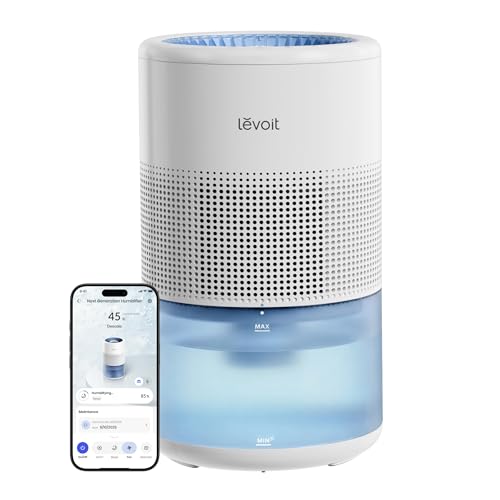
A bedroom or nursery, with no white dust
Levoit Superior Studio
$139.99 · 400 mL/h (2.5 gal/day) · 4.5 L tank · 600 sq ft claimed · evaporative · sold by Amazon.com
Evaporative, so the minerals stay in the wick and tap water is fine: EPA says evaporative and steam units are not expected to put out much mineral dust. 400 mL an hour (2.5 gallons a day), a 4.5 L tank, 19 dB on low, and a wick you can wash in a machine.
It costs $100 more than the ultrasonic pick. At full output the tank lasts 11.2 hours; the 40-hour figure is on low fan. The wick still needs cleaning; standing water grows bacteria in any type.
-
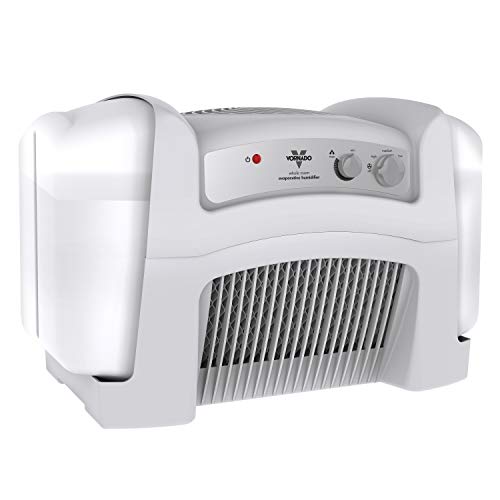
A large room or a small apartment
Vornado Evap40
$109.99 · 4 gal/day stated · 15.1 L tank · 1,000 sq ft claimed · evaporative · sold by Amazon.com
States its output as a day's figure, 4 gallons a day, from a 4-gallon tank, so the tank and the output agree: one fill, one day at its stated top output. Evaporative, with a built-in humidistat and a 5-year replacement promise on the listing.
The 1,000 sq ft claim is 250 sq ft per gallon a day; AprilAire's own FAQ works out to 136 to 188 for a typical house, so plan on a large room and not the whole floor. Two wicks to replace. It says "Certified, safety-tested, and warrantied for use only in the U.S." without naming by whom.
-
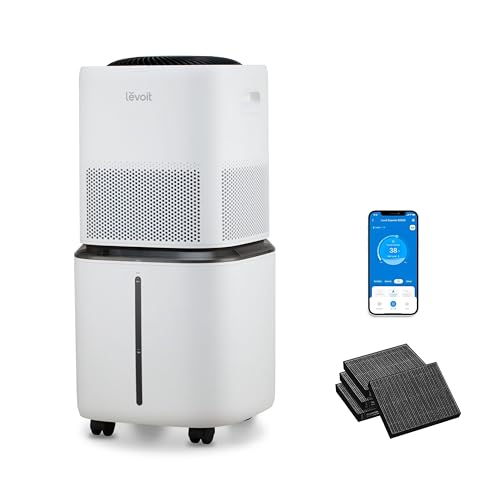
An open floor plan, without ductwork
Levoit Superior 6000S
$249.99 · 1,500 mL/h (9.5 gal/day) · 23 L tank · 3,000 sq ft claimed · evaporative · sold by Amazon.com
The most output of any room unit in the set: 1,500 mL an hour (9.5 gallons a day), evaporative, tap water, a 23 L (6-gallon) tank, and a humidity sensor. That is about 80% of the 12 gallons a day AprilAire's smallest furnace unit states.
At full output the tank lasts 15.3 hours; the 72 hours is on low. The 3,000 sq ft claim is 315 sq ft per gallon a day, more than AprilAire's listing allows even for a tight house. It is a large floor unit to carry to a sink.
-

The whole house, on a gas or oil furnace
AprilAire 600M
$247.58 · 17 gal/day stated · 5,000 sq ft claimed · whole-house evaporative · sold by Amazon.com
17 gallons a day, AprilAire's own figure (its site footnotes it to AHRI Guideline F, a sizing guideline, not an output test), which is more than any room unit here states. It mounts on the furnace duct and runs off a water line, so there is no tank to fill or scrub.
It needs ducted heat, a water line, a drain and a 24 V connection; the listing is the unit alone. AprilAire's FAQ says the 600 is good for homes up to 3,000 sq ft; the listing's 5,000 is for "tightly built homes". Replace the water panel once a season.
-
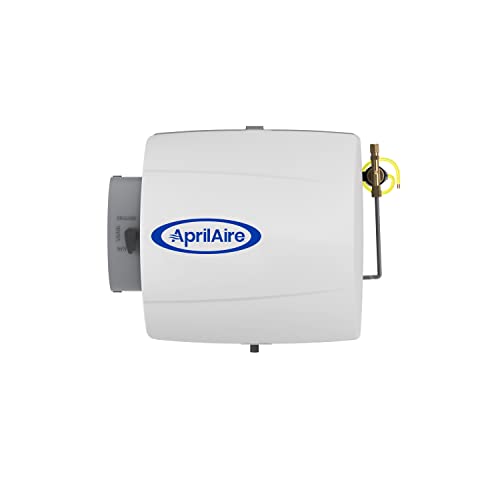
The whole house, set and forget
AprilAire 500 (automatic)
$284.99 · 12 gal/day stated · 3,600 sq ft claimed · whole-house evaporative · sold by Amazon.com
12 gallons a day with AprilAire's automatic control: the listing says its dual sensors "monitor and respond to both outdoor temperature and indoor relative humidity". The same 12 gallons a day as the manual 500M, for a house up to about 1,500 sq ft by AprilAire's FAQ.
It costs $55 more than the manual 500M. The 3,600 sq ft on the listing is for "tightly built homes"; AprilAire's FAQ says the 500 is "usually good for homes up to 1,500 sq. ft." Same install needs as the 600M.
Pass the rule, not picked: Levoit NeoClassic 450 ($42.49, 270 mL an hour; the DREO pick is $2.50 less and names its method); Levoit OasisMist 1000S ($149.99, 350 mL an hour; the Vornado states more for $40 less); DREO DR-HHM014S (three listings, $143.97 to $159.99, 800 mL an hour, 10 L tank that lasts 12.5 hours at that rate); Dreame H40 ($139.99, 800 mL an hour, a 6 L tank that lasts 7.5 hours at that rate); AprilAire 500M ($229.83, or $264.99 with the install kit, 12 gallons a day: the 600M states 17 for $17.75 more); AprilAire 700M ($469.99, 18 gallons a day, fan-powered); AprilAire 800 steam ($1,119.99, up to 34.6 gallons a day, 120 to 240 V; the 2023 recall covered AprilAire 800s made June 2010 to January 2015 with a "D" shaped electrode connector). Not eligible: the third-party Clarston ($24.99, 200 mL an hour), iFeiCho, Lacidoll, Jingkey, Provirtec, akacozie and GeneralAire listings, and every listing with no stated output. Amazon prices on 2026-09-27; they change. Affiliate links; we earn a commission at no cost to you.
09 / The three claims
"Up to 50 hours", "covers 1,000 sq ft" and "whole house", traced to their sources
Three phrases do most of the selling on these listings. Here is what each one comes to by the listing's own numbers or the maker's own page.
- "Up to 50 hours" (DREO DR-HHM014S)
- 12.5 hoursat its own 800 mL an hour; 50 hours is 200 mL an hour 1
- "Covers up to 1,000 sq ft" (Vornado Evap40)
- 250 sq ft per gal/dayAprilAire's FAQ works out to 136 to 188 for a typical house 2
- "Up to 3,600 sq ft" (AprilAire 500)
- 1,500 sq ftthe same maker's FAQ, for a house that is not "tightly built" 2
- "Whole house" on a floor unit
- 3 consoles, 0 outputsAIRCARE claims 2,700 to 4,000 sq ft with no output stated 1
- Listing "Delivers up to 800ml/h of ultra-fine vapor" and "With a spacious 10L tank ... runs up to 50 hours", from the same DREO listing. Both are true on different settings; the listing does not say which. 1
- Maker "The AprilAire 500 Humidifier can add up to about 11 gallons of humidity to your home daily, which is usually good for homes up to 1,500 sq. ft." The Amazon listing for the same unit says 3,600 sq ft "in tightly built homes". 2
- Report ENERGY STAR's 2012 scoping report says portable units cover one room or several, and "in rare circumstances, a small home (up to 2,500 square feet)". 18
- Listing 6 room units, two of the picks among them, use the words "whole house" at 500 to 3,000 sq ft; the Jingkey HQ-JS915 is a 500 sq ft unit sold as one of the "Best whole house humidifiers". 1
10 / Original research
54 Amazon bestsellers, read by hand
Creators API pull on 2026-09-27: "humidifier", "cool mist humidifier", "humidifier for bedroom", "large room humidifier", "evaporative humidifier", "warm mist humidifier", "whole house humidifier", "furnace humidifier", "humidifier for large room evaporative". No registry exists to match against (see the findings). Gallons a day = mL an hour × 24 ÷ 3,785. Hours at top output = tank ÷ stated top output. Sq ft per gallon a day = the room claim ÷ the stated output. These are arithmetic from the listing, not measurements. A gate checks every quoted fragment against the listing text before deploy.
We took the top results for 9 Amazon searches and read each listing's tank, output, room size, run time, water advice, humidity range, certification wording and seller by hand. The table puts each claim beside what the listing's own numbers imply, with the verbatim words behind every hand-read cell in the download.
- Says no white dust
- 19%10 of 54 listings
- Humidistat
- 67%36 of 54 listings
- Contradicts itself
- 2%1 of 54 listings
- Wi-Fi
- 24%13 of 54 listings
- 24 of 54 state an output; 33 state a room size; 29 state a run time; 12 give a room size with no output.
- On the 15 listings (13 products) that state a tank, an output and a run time, the run time is 1.8 to 4.7 times the hours at top output (median 3.0 by product, 3.2 by listing).
- Room claims run 96 to 421 sq ft per gallon a day across the 21 that state both; 11 of 13 room products (13 of 15 listings) exceed the top of AprilAire's FAQ range (136 to 188).
- 1 of 26 mist listings advise distilled water; 9 of 12 evaporative room listings advertise no white dust; 7 let you set 90% or more.
- 0 of 54 name a safety listing; 2 say "certified" without naming a body. 1 states two figures that cannot both be true.
- 33 of 54 are sold by Amazon itself, 21 by third parties; 2 were low in stock on 2026-09-27. Prices run $19.99 to $1,119.99.
| Product | Price | Sold by | Kind | Tank (L) | Output, mL/h | Gal/day | Room claim (sq ft) | Run time on box (h) | Hours at top output | Sq ft per gal/day | Top RH setting (%) | Safety mark stated |
|---|---|---|---|---|---|---|---|---|---|---|---|---|
| Levoit Classic 160 | $29.79 | Amazon.com | cool mist, method not stated | 2.5 | — | — | — | 25 | — | — | — | none stated |
| Levoit NeoClassic 450 | $42.49 | Amazon.com | cool mist, method not stated | 4.2 | 270 | 1.71 | 432 | 42 | 15.6 | 253 | — | none stated |
| MegaWise Humi | $20.06 | Amazon.com | ultrasonic | 3.5 | — | — | — | — | — | — | — | none stated |
| DREO HM311 | $35.94 | Amazon.com | ultrasonic | 4 | — | — | — | 36 | — | — | — | none stated |
| DREO HM311 (black) | $35.99 | Amazon.com | ultrasonic | 4 | — | — | — | 36 | — | — | — | none stated |
| Levoit Dual 150 | $37.49 | Amazon.com | cool mist, method not stated | 3 | — | — | — | 25 | — | — | — | none stated |
| Vicks V150 steam vaporizer | $19.99 | Amazon.com | warm mist / steam | 5.68 | — | — | — | — | — | — | — | none stated |
| MEGAWISE 3.5L (2-pack) | $36.44 | Amazon.com | ultrasonic | 3.5 | — | — | — | — | — | — | — | none stated |
| iFeiCho HQ-JS2616 7L | $89.99 | Hushaotao1 | warm and cool mist, method not stated | 7 | 450 | 2.85 | 500 | 70 | 15.6 | 175 | 95 | none stated |
| DREO DR-HHM006 3L | $39.99 | Amazon.com | ultrasonic | 3 | 250 | 1.59 | 300 | 30 | 12 | 189 | — | none stated |
| Homvana H101 | $29.97 | Kujia LLC | cool mist, method not stated | 3.6 | — | — | — | — | — | — | — | unnamed 'certified' |
| Clarston 2L | $24.99 | CLARSTON | ultrasonic | 2 | 200 | 1.27 | — | 25 | 10 | — | — | none stated |
| Levoit Classic 160 (KUS) | $39.99 | Amazon.com | ultrasonic | 2.5 | — | — | — | 25 | — | — | — | none stated |
| Everlasting Comfort 2.5L | $32.27 | Upper Echelon Products | ultrasonic | 2.5 | — | — | — | 60 | — | — | — | none stated |
| Lacidoll 8L | $74.99 | smart tech life shop | ultrasonic | 8 | 300 | 1.9 | 800 | 48 | 26.7 | 421 | 95 | none stated |
| Levoit OasisMist 1000S | $149.99 | Amazon.com | cool mist, method not stated | 10 | 350 | 2.22 | 600 | 100 | 28.6 | 270 | — | none stated |
| Hiswelle 8L | $59.98 | Woot | cool mist, method not stated | 8 | — | — | 500 | 48 | — | — | 90 | none stated |
| DREO 747S 11L | $99.98 | Amazon.com | cool mist, method not stated | 11 | — | — | 700 | 100 | — | — | — | none stated |
| Jingkey HQ-JS915 7L | $89.99 | nuosipei | cool mist, method not stated | 7 | 350 | 2.22 | 500 | 60 | 20 | 225 | 95 | none stated |
| BREEZOME 6L | $49.99 | JIANGNUO | ultrasonic | 6 | — | — | 500 | 60 | — | — | — | none stated |
| Jingkey HQ-JS2609 10L | $99.99 | Lujianhk | cool mist, method not stated | 10 | 350 | 2.22 | 600 | 85 | 28.6 | 270 | 95 | none stated |
| Levoit Superior 6000S | $249.99 | Amazon.com | evaporative | 23 | 1500 | 9.51 | 3000 | 72 | 15.3 | 315 | — | none stated |
| Provirtec HC13 | $79.99 | Provirtec | evaporative | — | 330 | 2.09 | 200 | — | — | 96 | — | none stated |
| Levoit Superior Studio | $139.99 | Amazon.com | evaporative | 4.5 | 400 | 2.54 | 600 | 40 | 11.2 | 236 | — | none stated |
| Slientspin K50 | $49.99 | xuyuhan11 | evaporative | 3 | — | — | — | — | — | — | — | none stated |
| Honeywell HCM350B | $76.42 | Amazon.com | evaporative | 4.16 | — | — | — | 24 | — | — | — | none stated |
| Levoit Sprout evaporative | $169.99 | Amazon.com | evaporative | — | — | — | — | — | — | — | — | none stated |
| Vornado Evap40 | $109.99 | Amazon.com | evaporative | 15.14 | 630.9 | 4 | 1000 | — | 24 | 250 | — | unnamed 'certified' |
| DREO DR-HHM014S (black) | $159.99 | Amazon.com | evaporative | 10 | 800 | 5.07 | 1000 | 50 | 12.5 | 197 | — | none stated |
| DREO DR-HHM014S | $143.97 | Amazon.com | evaporative | 10 | 800 | 5.07 | 1000 | 50 | 12.5 | 197 | — | none stated |
| Vicks V745 warm mist | $39.49 | Amazon.com | warm mist / steam | 3.78541 | — | — | 600 | 12 | — | — | — | none stated |
| Coolfiqu 6L (KongCool) | $33.29 | KongCool-US | ultrasonic, warm and cool | 6 | — | — | — | 60 | — | — | — | none stated |
| Coolfiqu 6L (KongCool, 2nd listing) | $33.28 | KongCool-US | ultrasonic, warm and cool | 6 | — | — | — | 60 | — | — | — | none stated |
| Levoit LUH-O451S warm & cool | $79.97 | Amazon.com | warm and cool mist, method not stated | 4.5 | — | — | — | — | — | — | 60 | none stated |
| DREO DR-HHM003S warm & cool | $79.94 | Amazon.com | warm and cool mist, method not stated | 6 | — | — | 550 | — | — | — | 90 | none stated |
| Coolfiqu 6L (Yingzun) | $33.99 | Yingzun-US | ultrasonic, warm and cool | 6 | — | — | — | 60 | — | — | — | none stated |
| Honeywell HWM445B | $69.99 | Amazon.com | warm mist / steam | 5.68 | — | — | — | — | — | — | — | none stated |
| AprilAire 500M | $229.83 | Amazon.com | whole-house evaporative | — | 1892.7 | 12 | 3600 | — | — | 300 | — | none stated |
| akacozie 18L | $199.99 | cozy life shop | warm and cool mist, method not stated | 18 | 1000 | 6.34 | 2500 | 48 | 18 | 394 | 90 | none stated |
| AIRCARE Canyon console | $189.99 | AIRCARE AUTHORIZED | evaporative console | 17.98 | — | — | 3700 | — | — | — | — | none stated |
| AprilAire 500M + 5843 kit | $264.99 | Amazon.com | whole-house evaporative | — | 1892.7 | 12 | 3600 | — | — | 300 | — | none stated |
| AIRCARE Space Saver 831000 | $149.99 | AIRCARE AUTHORIZED | evaporative console | 22.71 | — | — | 2700 | — | — | — | — | none stated |
| AIRCARE Valiant EA1407 | $219.99 | AIRCARE AUTHORIZED | evaporative console | 18.93 | — | — | 4000 | — | — | — | — | none stated |
| sdanbom "500MK" | $199.99 | Sdanbom | whole-house evaporative | — | — | — | 3600 | — | — | — | — | none stated |
| AprilAire 600M | $247.58 | Amazon.com | whole-house evaporative | — | 2681.3 | 17 | 5000 | — | — | 294 | — | none stated |
| AprilAire 700M | $469.99 | Amazon.com | whole-house evaporative | — | 2839.1 | 18 | 5300 | — | — | 294 | — | none stated |
| GeneralAire 3200M | $139.99 | Ohio Supply | whole-house evaporative | — | 1892.7 | 12 | — | — | — | — | — | none stated |
| Honeywell Home HE240 | $219.99 | Amazon.com | whole-house evaporative | — | — | — | 3000 | — | — | — | — | none stated |
| AprilAire 800 steam | $1119.99 | Amazon.com | whole-house steam | — | 5457.3 | 34.6 | 10300 | — | — | 298 | — | none stated |
| AprilAire 500 (automatic) | $284.99 | Amazon.com | whole-house evaporative | — | 1892.7 | 12 | 3600 | — | — | 300 | — | none stated |
| Honeywell Home HE360 | $318.88 | Amazon.com | whole-house evaporative | — | — | — | 4500 | — | — | — | — | none stated |
| Dreame H40 | $139.99 | Amazon.com | evaporative | 6 | 800 | 5.07 | — | 24 | 7.5 | — | — | none stated |
| DREO DR-HHM014S (2nd listing) | $143.99 | Amazon.com | evaporative | 10 | 800 | 5.07 | 1000 | 50 | 12.5 | 197 | — | none stated |
| Kupuu H100 | $169.00 | kupuu US | evaporative | 6 | — | — | 646 | — | — | — | — | none stated |
Output, tank and room size are the listing's own. "Hours at top output" and "sq ft per gal/day" are arithmetic from those. Tanks given in gallons are converted at 3.785 L. Where a listing gives a range, the top of the range is used. Verbatim fragments, water advice, warm-mist temperature, filter and warranty are in the CSV download. Prices, sellers and stock are Amazon's on the build date.
This table is not offered as a download. It is built from Amazon listings and other sources we may not republish, so we show it on this page only.
11 / The consensus
What 22 sources say about humidifiers, and where they split
2 Regulator pages · 1 Recall notice · 3 Medical publishers · 2 Guidelines · 1 Standard · 1 Certification document · 4 Maker pages · 1 Measured test · 3 Editorial guides · 3 Trade pages · 1 Review
EPA and CPSC guidance, the 2012 ENERGY STAR report, AHRI, three medical publishers, two AAP pages, a Cochrane review, Consumer Reports, three editorial guides, a building scientist, two trade pages (HVAC.com and This Old House's install guide), four maker pages and a CPSC recall, in one table. The kind each steers you to is plotted in the findings above.
| Source | Who | Recommends | Their bottom line |
|---|---|---|---|
| EPA — Use and Care of Home Humidifiers (Indoor Air Facts No. 8) Regulator page · EPA 402-F-22-002, Revised June 2022; document read directly 2026-09-27 | U.S. EPA (no byline) | Groups humidifiers by size (console/portable/central) then flags 'Ultrasonic, which create a cool mist by means of ultrasonic sound vibrations' and 'Impeller, or "cool mist," which produces a cool mist by means of a … · 'Empty the tank, wipe all surfaces dry, and refill the water in portable humidifiers daily to reduce any growth of microorganisms.' 'Clean portable humidifiers every third day to … | EPA's ranking of humidifier types: ultrasonic and impeller units put tank water, minerals and microorganisms included, into the room, while evaporative and steam units leave the minerals behind in the wick or the pot. The cleaning burden falls hardest on the two 'cool mist' kinds most shoppers buy. |
| CPSC — Dirty Humidifiers May Cause Health Problems (Publication 5046) Regulator page · Publication 5046 08812 032012; document read directly 2026-09-27 | U.S. Consumer Product Safety Commission (staff safety alert, no byline) | — · 'Do not allow film and scale to develop in your humidifier. If possible, change the water in your room humidifier daily.' 'Use distilled or demineralized water in your room … | Film or scum on the tank 'may indicate' bacteria or fungi, and mineral scale gives them a surface to grow on. CPSC's fix: change the water daily if possible, and use distilled or demineralized water. |
| CPSC — Hunter Fan Recalls Humidifiers for Fire Hazard Recall notice · November 6, 2007; fetched 2026-09-27 | U.S. Consumer Product Safety Commission | Recalled product line: Hunter's warm-mist 'CareFree' humidifiers. · 'Water used in the humidifier can leak into the unit's electrical compartment, posing a fire hazard.' | About 84,000 Hunter CareFree warm-mist humidifiers were recalled because water could leak into the electrical compartment, a fire hazard. That is a different risk from the steam burns the pediatric sources warn about. |
| Mayo Clinic — Humidifiers: Ease skin, breathing symptoms Medical publisher · © 1998-2024 Mayo Foundation for Medical Education and Research; content fetched via mirror 2026-09-27 (mayoclinic.org itself returned HTTP 403 across 2 direct attempts) | Mayo Clinic Staff (Mayo Foundation for Medical Education and Research) | Describes five types: 'Central humidifiers... built into home heating and air conditioning systems... meant to humidify the whole house.' 'Ultrasonic humidifiers... use sound waves to release a cool mist.' 'Impeller … · 'Use distilled or demineralized water. Tap water contains minerals that can lead to the growth of bacteria inside your humidifier.' | Keep home humidity between 30% and 50%. Mayo's type-specific warning is against steam vaporizers in homes with children. |
| Cleveland Clinic — How You Can Tell if You Need a Humidifier Medical publisher · Published January 10, 2025; fetched 2026-09-27 | Cleveland Clinic Health Essentials; quotes pulmonologist Sobia Farooq, MD | Same five-type breakdown as Mayo Clinic: 'Central humidifier... Evaporator... uses a moistened filter... Impeller humidifier... produces a cool mist by using rapidly rotating disks. Steam vaporizer... Ultrasonic … · The writer's paraphrase: 'Dr. Farooq recommends changing the water daily to avoid any mold or bacteria growing in standing water.' 'Wash and sanitize any buckets or filter systems … | Keep home humidity between 30% and 50%, and keep oils and decongestant rubs out of the humidifier; vinegar is for cleaning, not the running tank. |
| HealthyChildren.org (AAP) — Cough & Cold Survival Kit: Symptom-Relief Essentials for Families Guideline · December 10, 2024; fetched 2026-09-27 | American Academy of Pediatrics | 'Cool-mist humidifiers generally are considered safer for young children than warm-mist humidifiers or steam vaporizers.' · 'Keep and follow the manufacturer's instructions on how to clean the humidifier or vaporizer. Without proper cleaning and upkeep, the machine can build up mold, bacteria and … | The AAP's household rule is burns first, germs second: pick cool mist over warm mist or steam because there's no scald risk, then keep it clean so it isn't dispersing mold, bacteria, and minerals instead. |
| HealthyChildren.org (AAP) — My baby has a stuffy nose. How can I help them sleep safely? Guideline · December 16, 2025; fetched 2026-09-27 | Rachel Y. Moon, MD, FAAP, American Academy of Pediatrics | 'Try using a vaporizer or humidifier to fill your baby's sleep space with a cool mist that helps clear their nasal passages' — only cool mist is discussed; warm mist is not mentioned on this page. · 'Change the water every day and follow the manufacturer's directions to keep mold and bacteria away.' | For a baby's sleep space specifically, Dr. Moon's guidance skips the warm-mist-vs-cool-mist debate entirely and just recommends cool mist, changed daily. |
| MedlinePlus (NIH/NLM) — Humidifiers (medical encyclopedia article) Medical publisher · Review date 10/20/2024; fetched 2026-09-27 | MedlinePlus Medical Encyclopedia; updated by Neil K. Kaneshiro, MD, MHA, Clinical Professor of Pediatrics, University of Washington School of Medicine | 'Always use a cool-mist humidifier (vaporizer), especially for children.' · 'Humidifiers must be drained and cleaned daily, because bacteria can grow in standing water.' | Set the unit to 40% to 50% humidity — a narrower band than the 30-50% most other sources in this panel give — and default to cool mist for the same burn-risk reason AAP and Mayo Clinic give. |
| AHRI — Humidifiers (residential HVACR equipment/components reference) Standard · current; fetched 2026-09-27 | Air-Conditioning, Heating, and Refrigeration Institute (no byline) | 'A central system or whole home humidifier is a device designed to add moisture to the home, and is installed directly into the central heating and cooling system.' 'Residential self-contained humidifiers are used in … | AHRI publishes rating standards for central-system (610) and self-contained (620) humidifiers, but none of its 38 certification programs covers humidifiers (checked 2026-09-27). The one maker in the set that footnotes its figure, AprilAire, cites Guideline F, not 610. |
| U.S. EPA / ENERGY STAR — Market & Industry Scoping Report: Residential Humidifiers Certification document · October 2012; document read directly 2026-09-27 | U.S. EPA / ENERGY STAR (no byline) | Portable humidifiers split into 'ultrasonic, cool mist, and warm mist'; whole-house into 'bypass, fan-powered, and steam technologies.' 'Warm Mist – Water is heated by an element... Cool Mist – A fan blows water towards … · Portable units need cleaning 'every 2-3 weeks' or mold/bacteria can grow; whole-house units need filter 'replacement approximately once every six months.' | As of this 2012 ENERGY STAR report, no federal minimum energy standard, no required test method and no AHRI or AHAM certification program existed for residential humidifiers: 'though AHAM and AHRI carry out certification programs for many other types of residential appliances and/or HVAC equipment, neither organization has implemented a certification program for residential humidifiers.' Dehumidifiers, by contrast, have a federal efficiency floor and an ENERGY STAR list. |
| AprilAire — Humidifiers FAQs Maker page · current; fetched 2026-09-27 | manufacturer | — · 'AprilAire Water Panels 10, 12, and 35 should be replaced once per heating season and the AprilAire Water Panel 45 should be replaced twice per heating season.' | AprilAire sizes by gallons a day against the house: about 11 GPD for 1,500 sq ft, 16–17 for 3,000, and 21 for 'tightly constructed large homes, up to 6,250' square feet. That is 136 to 188 sq ft per GPD for an ordinary house, and more only for a tight one. |
| Consumer Reports — How to Find the Right Humidifier for Any Room Measured test · Updated March 25, 2025; fetched 2026-09-27 | Tobie Stanger and Allen St. John, writers, Consumer Reports | 'Most of the models in our humidifier ratings are cool-mist units... Most use ultrasonic technology—a small vibrating diaphragm—to create the cool mist. (The evaporative models, which tend to be noisier, use a fan to … · 'A humidifier designed for a room that's larger than yours can create an overly moist environment that breeds dust mites and mold and triggers allergic reactions.' | Measure the room and match it: too small will not relieve dry-air symptoms, and too large can breed dust mites and mold. Consumer Reports gives 30 to 50% humidity, citing ENERGY STAR. |
| Consumer Reports — Top Reasons to Buy a Cool-Mist Humidifier Editorial guide · Updated April 2, 2025; fetched 2026-09-27 | Tobie Stanger (updated by Kala Herh), writers, Consumer Reports | 'Cool- and warm-mist units are equally effective at humidifying.' 'Warm-mist models tend to be quieter because they don't need a fan, nebulizer, or vibrating diaphragm to move moisture into the air.' · 'It's crucial to clean the components regularly to prevent the growth of mold spores and other nasties that can lead to illness.' | Cool and warm mist humidify equally well and warm mist is quieter, so Consumer Reports frames the choice as a safety decision, not a performance one: pick cool mist if there are kids or pets in the house, and be careful with dual-mist units specifically because a wrong button press can turn a 'safe' cool-mist unit into a scalding one. |
| Bob Vila — The Best Whole-House Humidifiers of 2026, Picks by Experts Editorial guide · Published September 23, 2026; fetched 2026-09-27 | Bob Beacham, writer, Bob Vila | 'Unlike single-room humidifiers, which moisturize the air in small spaces, whole-house systems provide a single, convenient source of balanced humidity.' · 'Filters should be changed every 3 to 12 months, depending on the type of humidifier.' For HVAC-integrated models, 'an annual service is usually recommended... and some components … | A leaky, undersealed home isn't just less energy efficient — Bob Vila's own buying guide says it can require a whole-house humidifier '40 to 50 percent more powerful' than the same square footage in a tight home, tying humidifier sizing to the building envelope, not just floor area. |
| This Old House — 5 Best Humidifiers (2026) Editorial guide · Updated June 18, 2025; fetched 2026-09-27 | Alexis Carthan, writer, This Old House | Recommends readers 'look for an ultrasonic model that operates at a high frequency that human ears can't hear'; notes one reviewed Levoit unit 'offers a warm mist setting' as an add-on option. · Weekly cleaning routine: 'Disassemble the humidifier. Pour one to two cups of white vinegar into the tank,' let it sit '15-20 minutes,' and 'rinse the tank daily with tap water'; … | Sizes by tank volume rather than a formula — a 4-liter tank for a small room, 6+ liters for a large one — and treats a built-in filter, not just a low-noise ultrasonic mechanism, as the feature that keeps a unit from growing bacteria. |
| This Old House — Installing a Whole House Humidifier Trade page · Updated May 29, 2026; fetched 2026-09-27 | Ross Trethewey, This Old House (Ross Trethewey) | Describes an electrode steam system: 'The system is installed near the main heating system, and inside the humidifier is a water tank... The steam then travels through a pipe to the humidifier wand, which is installed … · 'All that service requires is replacing the tank and cleaning the electrodes every two to three years.' The unit 'will sense the amount of minerals that build up in the cylinder. … | For a whole-house steam unit, sizing depends on 'the square footage of your house, the air leakage of your house, your bath fans', not floor area alone. The unit senses mineral build-up and flushes its cylinder; service is a new cylinder and clean electrodes every two to three years. |
| Honeywell Home — Humidifiers Maker page · current; fetched 2026-09-27 | manufacturer | Evaporative bypass humidifiers 'efficiently pull warm air through a moistened pad, distributing balanced humidity throughout your home'; page lists evaporative by-pass, evaporative fan-powered, and steam options. · Points buyers to 'Humidifier Parts like replacement pads to keep your humidifier running smoothly year-round.' | Honeywell markets whole-home humidification as HVAC integration ('seamlessly integrates into your HVAC system'), leaning on its evaporative bypass and fan-powered lines rather than a portable-unit pitch. |
| Levoit — Introducing Levoit Superior Studio: An Evaporative Humidifier Without White Dust Maker page · June 16, 2026; fetched 2026-09-27 | manufacturer | 'Superior Studio was intentionally designed to eliminate the frustrations of ultrasonic models, from the type of humidification to the cleaning process,' by switching to evaporative technology. · 'Evaporative technology eliminates white dust, allowing easy use with tap water without requiring distilled or purified water.' | Levoit, best known for ultrasonic units, says it designed this evaporative model to 'eliminate the frustrations of ultrasonic models', white dust among them. |
| Vornado — EV100 Evaporative Humidifier Maker page · current; fetched 2026-09-27 | manufacturer | 'The EV100 sets the standard for whole-room humidification using natural evaporation,' using 'special airflow called Vortex Action to humidify all the air in the room.' · Replacement wick part listed ('MD1-0034 Humidifier Wick (2-Pack)'); ships with '1 Filter Included' and an 'easily cleanable humidifier and grill.' | Vornado's own pitch is explicitly against ultrasonic mist: the product 'eliminates the mist and messy white dust other humidifiers leave behind' by evaporating water into pure vapor instead of spraying tank water into the room. |
| Byber et al. — Humidification of indoor air for preventing or reducing dryness symptoms or upper respiratory infections in educational settings and at the workplace (Cochrane Database of Systematic Reviews) Review · December 10, 2021 (2021;2021(12):CD012219); fetched 2026-09-27 | Kyra Byber, Thomas Radtke, Dan Norbäck, et al., Cochrane Database of Systematic Reviews (systematic review authors) | Covers 'central or building-level interventions that increase air humidity with air conditioning systems or whole-house humidifiers' and 'local or room-level interventions, such as separate air humidifiers,' … · 'Perceived stuffiness of the air was increased during the humidification' in two of the included studies — an adverse effect, not a benefit. | The evidence for humidifying indoor air at work or school is thin: 'Indoor air humidification at the workplace may have little to no effect on dryness symptoms,' with evidence quality rated 'LOW' to 'VERY LOW' across outcomes, one bright spot ('a significant decrease in dry eye symptoms'), and one downside (increased perceived stuffiness) — not a ringing endorsement of humidification as therapy in the settings this review covers. |
| Energy Vanguard — Is a Humidifier in an Airtight House Ever Needed? Trade page · January 8, 2026; fetched 2026-09-27 | Allison A. Bailes III, PhD, Building science engineer and founder, Energy Vanguard | — · 'If you have a constant problem with condensation on the windows, you may be in danger of rotting the building.' Practical test: 'The humidity should be low enough that you don't … | 'A good range for indoor relative humidity in winter then would be 30 to 45 percent', narrower than the medical sources' 30 to 50%. Bailes's test is the windows: no more than a bit of condensation. The article asks whether a tight, well-built house needs a humidifier at all. |
| HVAC.com — How to Buy a Whole-House Humidifier Trade page · August 1, 2023; fetched 2026-09-27 | HVAC.com (no individual byline) | Evaporative models 'pass warm air through an evaporator pad, which is a ceramic-coated pad saturated with water'; steam units 'heat water in a canister and convert the water to steam, which the unit forces through your … · Evaporative: 'replacing the humidifier pad annually, as prolonged use may reduce the pad's ability to absorb water.' Steam: 'you should flush sediment from the tank annually.' | A rougher rule than AprilAire's model-by-model figures (12 GPD for 3,000 sq ft here, against AprilAire's 16–17): two published yardsticks that do not agree, and neither is checked by a third party. |
Where they agree
- Hold 30 to 50%. EPA, CPSC, Mayo Clinic, Cleveland Clinic and Bob Vila say it; MedlinePlus and the building scientist narrow it to 40–50% and 30–45%. The AprilAire, Vicks and Honeywell listings say 40 to 60%.
- Change the water daily. EPA, CPSC ("if possible"), Cleveland Clinic, MedlinePlus and the AAP say so. EPA puts the scrub at every third day and Cleveland Clinic at every two to three days; This Old House's once a week or every two weeks is looser.
- Cool mist around children. The AAP, Mayo Clinic, MedlinePlus and Consumer Reports agree; EPA says steam can burn.
- Ultrasonic mist carries the minerals. EPA, CPSC, MedlinePlus and two makers (Levoit and Vornado) say so; the fix is distilled water or an evaporative unit.
Where they split
- How do you size one? — Consumer Reports: measure the room and match the maker's square footage. This Old House: by tank, 4 L for a small room, 6 L or more for a large one. AprilAire's FAQ: gallons a day against the house. HVAC.com: about 12 gallons a day for 3,000 sq ft. Bob Vila: add 40 to 50% for a drafty house. Square footage on the box has no standard behind it, and the listings here claim 96 to 421 sq ft per gallon a day. Tank size tells you how often you refill. The stated output is the only figure that measures humidification. AprilAire's FAQ (136 to 188 sq ft per gallon a day) and HVAC.com (about 250) are the two published yardsticks in the set, and they disagree; the lower number is the safer size.
- Ultrasonic or evaporative? — This Old House recommends a high-frequency ultrasonic for quiet. Consumer Reports notes most tested units are ultrasonic and evaporative ones are louder. EPA ranks ultrasonic and impeller units highest for dispersing minerals and microbes; Levoit built its evaporative Studio line to end the white dust its ultrasonic units make. Ultrasonic is quieter and cheaper; evaporative is cleaner with tap water. If you will buy distilled water every week, ultrasonic is fine. If you will not, buy evaporative.
- Does a humidifier help your health? — AprilAire's listings say mid-range humidity "has been shown to reduce the incidence of respiratory infections". Vicks and Honeywell say it relieves coughs and congestion. A Cochrane review of schools and workplaces found humidification may have little to no effect on dryness symptoms, on low- to very-low-quality evidence. The evidence for health benefits is weak; the evidence that a dirty humidifier can harm you is in CPSC's own findings. Buy one if a hygrometer reads under 30%, for comfort, static and wood, and keep it clean.
Who is cited
Who is cited on this page
Named people with a verifiable published position, fetched directly on the build date. Quotes are verbatim from the linked page. No one listed reviewed this page. Good Housekeeping, CNET, Dyson, Vicks (Kaz Inc.), Levoit's own troubleshooting support article, The Spruce, Popular Mechanics, Family Handyman, RTINGS.com, and Tom's Guide could not be fetched (blocked at the tool level, HTTP 403/401, or no locatable URL), so no bylines from those outlets appear here; the attempts are recorded in the consensus panel's failed_sources.
- Sobia Farooq, MD pulmonologist, quoted in Cleveland Clinic Health Essentials
Certain essential oils can have implications for indoor air quality and could potentially impact respiratory health.
Cleveland Clinic Health Essentials, "How You Can Tell if You Need a Humidifier" · 2025-01-10 ↗ - Rachel Y. Moon, MD, FAAP pediatrician, American Academy of Pediatrics (HealthyChildren.org)
Try using a vaporizer or humidifier to fill your baby's sleep space with a cool mist that helps clear their nasal passages.
HealthyChildren.org (AAP), "My baby has a stuffy nose. How can I help them sleep safely?" · 2025-12-16 ↗ - Neil K. Kaneshiro, MD, MHA Clinical Professor of Pediatrics, University of Washington School of Medicine; medical reviewer of the MedlinePlus article quoted (the words are MedlinePlus's)
Use distilled water instead of tap water. Tap water has minerals that can collect in the unit.
MedlinePlus Medical Encyclopedia, "Humidifiers" · 2024-10-20 ↗ - Tobie Stanger writer, Consumer Reports
To find the right humidifier, calculate your room's square footage (by multiplying the width by the depth).
Consumer Reports, "How to Find the Right Humidifier for Any Room" · 2025-03-25 ↗ - Bob Beacham writer, Bob Vila
Those homes that aren't fully insulated or have occasional drafts could require a model 40 to 50 percent more powerful for effective humidification.
Bob Vila, "The Best Whole-House Humidifiers of 2026, Picks by Experts" · 2026-09-23 ↗ - Alexis Carthan writer, This Old House
A humidifier that can hold six or more liters works in large rooms, while a four-liter humidifier is better for small rooms.
This Old House, "5 Best Humidifiers (2026)" · 2025-06-18 ↗ - Ross Trethewey This Old House (technical/engineering contributor)
That's based on the square footage of your house, the air leakage of your house, your bath fans, et cetera.
This Old House, "Installing a Whole House Humidifier" · 2026-05-29 ↗ - Allison A. Bailes III, PhD Building science engineer and founder, Energy Vanguard
A good range for indoor relative humidity in winter then would be 30 to 45 percent.
Energy Vanguard, "Is a Humidifier in an Airtight House Ever Needed?" · 2026-01-08 ↗
Cited without a named author: the EPA fact sheet and its linked CPSC alert, the CPSC Hunter Fan recall notice, Mayo Clinic Staff, AHRI, the 2012 ENERGY STAR scoping report, the AAP's Cough & Cold Survival Kit, Aprilaire, Honeywell, Levoit's Superior Studio brand post, Vornado, HVAC.com, and the Cochrane review (Byber, Radtke, Norbäck et al.); their pages are in the sources list. Building scientist Lew Harriman is quoted within Allison Bailes's Energy Vanguard article but is not listed above because his own stated credential was not visible in the fetched excerpt. Good Housekeeping, CNET, Dyson, Vicks, Levoit's troubleshooting support article, The Spruce, Popular Mechanics, Family Handyman, RTINGS.com, and Tom's Guide could not be fetched (blocked at the tool level, HTTP 403/401, or no locatable URL), so no bylines from those outlets appear here; the attempts are recorded in the consensus panel's failed_sources.
13 / Questions
Frequently asked
- What size humidifier do I need?
- Size on the stated output, in gallons a day, against your floor area. AprilAire's FAQ puts about 11 gallons a day at a 1,500 sq ft home and 16 to 17 at 3,000 sq ft: 136 to 188 sq ft per gallon a day. To be safe, divide your floor area by about 135; a drafty house needs more. For a room unit, convert mL an hour × 24 ÷ 3,785. Skip the room size on the box: the listings here claim 96 to 421 sq ft per gallon a day, and there is no standard behind any of them. 271
- Is a humidifier's output certified by anyone?
- No. AHAM wrote the test (HU-1) but certifies air cleaners, filters, bath fans and range hoods; its directory lists 313 air cleaners and no humidifiers. AHRI has rating standards for furnace humidifiers, but none of its 38 certification programs covers them. ENERGY STAR has no humidifier category, and its 2012 report found no test method a maker is required to use before printing a water-output claim. AHAM's one humidifier certification mark was cancelled in 2004. Consumer Reports measures output in its lab, for the models it rates. 11818194
- Why does the tank run out so much faster than the box says?
- Because the run time is measured at a lower setting. On the 15 listings that print a tank, a top output and a run time, the run time is 1.8 to 4.7 times longer than the tank lasts at the top output (median 3.0 by product). By product, the run times imply a median of about 117 mL an hour, against a median stated top output of 350. 6 of the 13 products say the run time is on low or sleep mode; the rest do not say. 1
- Evaporative or ultrasonic: which is better?
- Evaporative if you will use tap water; ultrasonic if you will buy distilled water and want quiet. EPA says ultrasonic and impeller units "appear to produce the greatest dispersions of both microorganisms and minerals", and that evaporative and steam units are not expected to put out much mineral dust. CPSC says tap-water minerals come out as fine white dust that can reach the lungs. 1 of the 26 mist listings in the set tells you to use distilled water. 20221
- Warm mist or cool mist for a baby?
- Cool mist, out of reach. The AAP says cool-mist units "generally are considered safer for young children than warm-mist humidifiers or steam vaporizers" because there is no risk of burns. EPA says steam and boiling water may cause burns. Consumer Reports adds that dual-mist units can switch to hot mist at the press of a button. 3204
- What humidity should I set?
- Between 30 and 50%. EPA says never above 50%; CPSC says above 60% moisture condenses on surfaces where bacteria and fungi grow. In a cold winter, building scientist Allison Bailes suggests 30 to 45% and a check of the windows: a little condensation at most. 7 listings here let you set 90 or 95%. 20226
- Can I use tap water in a humidifier?
- In an evaporative or steam unit, yes. In an ultrasonic or impeller unit, EPA and CPSC both say to use distilled or demineralized water, because tap-water minerals come out in the mist as white dust. EPA notes that "spring", "artesian" or "mineral" bottled water has not been treated to remove minerals. 2022
- How often should I clean a humidifier?
- Empty, wipe dry and refill every day, and scrub the tank every third day, per EPA. CPSC has found bacteria and fungi "often grow in the tanks of portable and console room humidifiers and can be released in the mist." Replace wicks and pads as the maker says; AprilAire says its water panel annually. 2022
- Is a whole-house humidifier worth it?
- If you have forced-air heat and want more than one room humidified, yes: the AprilAire bypass and fan-powered listings and GeneralAire's state 12 to 18 gallons a day (AprilAire's 800 steam unit up to 34.6), and a furnace unit runs off a water line with no tank to scrub. It needs ductwork, a water line, a drain and usually a contractor. AprilAire's FAQ puts the 500 at homes up to 1,500 sq ft and the 600 at 3,000. With short furnace run times (a heat pump, for example), AprilAire sells a steam unit instead. 23739
- Have humidifiers been recalled?
- CPSC's recall database lists 12 humidifier recalls from 1977 to 2023, about 2.4 million units (one recall's count includes Canada), 11 of them for fire or overheating. The most recent, in June 2023, covered about 36,200 steam humidifiers from Research Products sold as AprilAire 800, 801, 865 and 866 and under Carrier, Bryant, York, Coleman and Luxaire names, after 103 overheating reports and 10 smoke or fire incidents. 2331
14 / References
Sources
- 1
- 2
- 3
- 4
- 5
- 6
- 7
- 8
- 9
- 10
- 11
- 12
- 13
- 14
- 15
- 16
- 17
- 18
- 19
- 20
- 21
- 22
- 23
- 24
- 25
- 26
- 27
- 28
- 29
- 30
- 31
- 32
- 33
- 34
- 35
- 36
- 37
- 38
- 39
- 40
- 41
- 42
- 43
- 44
12 / Field reports
What 897 comments from 264 humidifier threads actually argue about
897 humidifier comments · from 264 threads · r/HomeImprovement, r/hvacadvice · 2015-03 to 2026-09
Harvested from r/hvacadvice and r/HomeImprovement, where people ask installers and each other about humidifiers, then filtered to the comments that themselves name a humidifier or a humidifier brand. The harvest leans to whole-house units, because most threads came from r/hvacadvice. The shares below are of those comments, not of the whole harvest. Every quote is verbatim and links to the comment.
Share of humidifier comments that raise each theme
The room-unit complaint these threads return to is the white film an ultrasonic unit leaves on everything when it runs on tap water. The fixes people report are the two EPA gives: distilled or reverse-osmosis water, or a switch to a wick. Two commenters say ultrasonic minerals turn gas flames orange; one says the gas company tech spotted the cause in seconds.
Upkeep advice is plain: vinegar now and then, a new pad each heating season, and a humidity meter so the house never runs much past 50%. One commenter warns that a whole-house unit can spread legionella if the water heater feeding it runs cool.
Owners who moved from ultrasonic to a wick say they did it to stop the dust without buying distilled water; one goes through a gallon a day and replaces cheap wicks monthly.
The largest theme by far, because the harvest leans on r/hvacadvice. The points made most often: a bypass unit only works while the furnace runs, the pad wants replacing each season, the water valve should be set so only a trickle reaches the drain, and a steam unit (AprilAire's 800 is the one named) is the answer for a heat pump or a high target, at the cost of a 240 V circuit.
The threads use the windows as the gauge. One owner says a whole-house unit cannot be run at 40% or more all winter without condensation on the windows; another commenter calls 40% "fairly high" when it is below freezing outside. The top comment: over 60% and you get mold, and around 50% is comfortable.
Few comments give numbers. The ones that do say the square footage on the box does not match what the units do, and one commenter puts a leaky house at 20 to 30 gallons a day, more than any evaporative furnace unit in the decode states.
Nosebleeds and dry sinuses are the reasons people give. One owner with a whole-house unit still runs a room unit in the room they are in, because the house cannot be held that high without wet windows.
Steam comes up for two reasons: warm-mist room units crust up like ultrasonic ones, and whole-house steam is what installers suggest with a heat pump. One owner of a GeneralAire steam unit says his January and February electric bill matched his July and August air-conditioning bill.
A small theme. Wood floors and grand pianos are the reason one commenter gives for paying for steam, and another lists wood and leather cracking in a very dry house.
Products the community names most
Reddit search across 8 communities for 14 queries, then each thread's top comments read, up to the harvest's thread cap; the threads that made the cut came from r/HomeImprovement, r/hvacadvice. 420 threads and 4,597 comments were harvested, of which 897 humidifier-naming comments are the denominator here. Themes are keyword matches over that set, each one's quote being a high-scoring comment that carries both the humidifier term and the theme term, verbatim and linked. Harvested 2026-09-27.