Best Small Heater for Under a Desk at an Office
For most desks, buy the Dreo Atom 316 (HSH006): 11.02 inches tall, 34 dB quiet, with a thermostat, tip-over and overheat shutoff and an ETL mark in its listing. Ask your office first, since some ban heaters or require 3 feet of clear space; it costs $2.18 a workday at full power, and a 400 W mini heater costs 58¢.

Best for most office desks
Dreo Atom 316 (HSH006)
$35.96 on Amazon
Check price on Amazon- Its listing states a thermostat, tip-over and overheat shutoff and an ETL mark: the list North Carolina's state offices require.
- 34 dB, the quietest of the desk-size heaters here that state a noise level. 11.02 inches tall.
- A timer, so it switches itself off before you leave for the day.
- It is a full 1,500 W heater: about 12.5 amps, so plug it straight into a wall outlet, never a power strip.
- Sold and shipped by Amazon.
The desk heaters ChatGPT recommends, checked
Asked for the best small heater for under an office desk, ChatGPT names these models. Here is what each one's own Amazon listing states about the safety features workplace rules ask for, and what it costs for an 8-hour workday.
-
 $34.99 on Amazon
ChatGPT: best for everyday office use and a compact footprint
Vornado VH202 · 750 W (maker spec) · no safety mark stated · $1.09 a workday
Its listing states tip-over shutoff, but not a thermostat, an overheat shutoff or a UL, ETL or CSA mark. Vornado's own spec sheet lists "Heat Regulation: None", so it has no thermostat.
-
 $29.44 on Amazon
ChatGPT: best for a tiny, low-power heater for warmth near your feet
Lasko MyHeat Mini (201) · 400 W · ETL mark · 58¢ a workday
Its listing states overheat shutoff and an ETL mark, but not a thermostat or a tip-over shutoff.
-
 $39.99 on Amazon
ChatGPT: best for an office that is really cold
Dreo Atom 316 (HSH006) · 1,500 W · ETL mark · $2.18 a workday · passes our safety screen
Its listing states a thermostat, tip-over shutoff, overheat shutoff and an ETL mark.
-
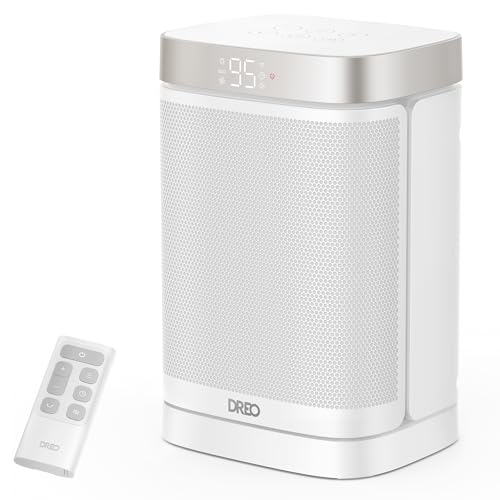 $60.49 on Amazon
ChatGPT: best for stronger heat and adjustable comfort
Dreo Atom One · 1,500 W · ETL mark · $2.18 a workday · passes our safety screen
Its listing states a thermostat, tip-over shutoff, overheat shutoff and an ETL mark.
-
 $49.99 on Amazon
ChatGPT: best for quiet, fan-free warmth for your legs
Cozy Products Cozy Legs (CL) · 150 W · ETL mark · 22¢ a workday
Its listing states a thermostat and an ETL mark, but not a tip-over shutoff or an overheat shutoff. It is zero-clearance-rated, by its maker's listing. Sold on Amazon by a third-party seller.
-

ChatGPT: best for gentle warmth at your feet on a budget
Lasko MyHeat Personal (101) · 200 W · ETL mark · 29¢ a workday
Its listing states overheat shutoff and an ETL mark, but not a thermostat or a tip-over shutoff.
Models from ChatGPT's answers to "What is the best small heater for under a desk at an office?", asked October 25, 2026. Safety facts are each Amazon listing's own words; Vornado's watts are from its own spec sheet.
Which one is right for you?
- See the cost in your state
Cheapest to run
The lowest-watt heater that keeps you warm · 7¢ an hour at 400 W, 27¢ at 1,500 W
Every heater turns all its power into heat, so cost follows watts. A 400 W heater costs about a quarter as much to run as a 1,500 W one, and makes about a quarter of the heat.
- See space heater picks
For a whole cold room
A full-size space heater · 1,500 W, with a thermostat
Heating a home office room, not just your feet? Our space heater page picks by room, with the same safety screen.
Prices are Amazon's on November 4, 2026. Picks are sold by Amazon. Workday costs are at the U.S. average home power price.
01 / At work
Can you use a space heater at work? What office rules say
Before you buy, ask facilities or HR. The two workplace rules we read in full, for U.S. congressional offices and North Carolina state offices, say three things: get permission, keep 3 feet clear, and turn the heater off when you leave.
- Ask first. Your workplace may not allow heaters at all. “Check with your employer to see if they allow space heaters in your workplace and, if they do, whether they have a list of approved devices.” (OCWR)
- Under a desk, 3 feet of clear space is hard to keep. “Space heaters shall not be used under desk or other furniture or equipment unless the aforementioned space requirements shall be met.” (North Carolina) “A minimum three feet area around, in front of, and above the space heater or an area greater as recommended by the manufacturer will be maintained around the space heater as clearance from combustibles.” (North Carolina)
- Foot warmers and heated pads count as heaters too. “this also includes items such as but not limited to electric blankets, pads, “foot warmers” and similar products that produce heat from an electrical or fuel source.” (North Carolina)
- Some rules list the safety features a heater must have. “The space heater must contain fully enclosed heating surfaces, be provided with a thermostat, tip over safety shut off, and be listed by an approved listing agency such as Underwriter Laboratories” (North Carolina) “Look for a space heater that has safety features such as a tip-over switch, overheat sensor, and touch sensor.” (OCWR)
- Plug it straight into a wall outlet. “Plug space heaters directly into a grounded wall outlet, not an extension cord or a power strip.” (OCWR)
- Turn it off when you leave your desk. “Never leave a space heater unattended. Turn the heater off before leaving your workspace” (OCWR)
- If the breaker trips, call facilities. “Electrical circuits shall not be overloaded. Do not reset any tripped breakers.” (North Carolina)
These are the rules for U.S. congressional offices (OCWR) and North Carolina state offices. Your employer's may be stricter or looser. A heater the lab rated zero-clearance, like the Cozy Legs panel, is made to sit close to things, but a rule like North Carolina's still asks for 3 feet.12
02 / Cost
What a desk heater costs per hour and per workday, by state
A heater turns every watt it draws into heat, so the cost depends only on its watts and your power price. At the U.S. average home price of 18.2¢ per kWh (EIA, January through July 2026), an 8-hour workday at full power costs 22¢ at 150 W, 58¢ at 400 W, $1.09 at 750 W and $2.18 at 1,500 W.6
Watts are also heat: 400 W makes 1,365 Btu an hour and 1,500 W makes 5,118 (EIA: 1 kWh = 3,412 Btu). A low-watt heater warms your feet and hands. It will not warm a cold office.7
Circuits: amps = watts ÷ 120 volts. A 1,500 W heater draws 12.5 amps, most of what a 15-amp circuit can carry, and your computer and monitors share that circuit. A 400 W heater draws 3.3 amps and a 150 W panel 1.25.
These are home electricity prices. At work, your employer pays the bill. A thermostat that cycles the heater off lowers the real cost; these figures are the most it can cost, running all day.
| State | 150 W | 400 W | 750 W | 1,500 W |
|---|---|---|---|---|
| U.S. average 18.2¢/kWh | 22¢ | 58¢ | $1.09 | $2.18 |
| Alabama 16.5¢/kWh | 20¢ | 53¢ | 99¢ | $1.98 |
| Alaska 27.1¢/kWh | 33¢ | 87¢ | $1.63 | $3.25 |
| Arizona 15.4¢/kWh | 19¢ | 49¢ | 93¢ | $1.85 |
| Arkansas 13.6¢/kWh | 16¢ | 44¢ | 82¢ | $1.63 |
| California 33.3¢/kWh | 40¢ | $1.06 | $2.00 | $3.99 |
| Colorado 16.7¢/kWh | 20¢ | 54¢ | $1.00 | $2.01 |
| Connecticut 28.0¢/kWh | 34¢ | 90¢ | $1.68 | $3.36 |
| Delaware 17.9¢/kWh | 21¢ | 57¢ | $1.07 | $2.14 |
| District of Columbia 24.7¢/kWh | 30¢ | 79¢ | $1.48 | $2.96 |
| Florida 15.3¢/kWh | 18¢ | 49¢ | 92¢ | $1.84 |
| Georgia 15.4¢/kWh | 18¢ | 49¢ | 92¢ | $1.85 |
| Hawaii 46.3¢/kWh | 56¢ | $1.48 | $2.78 | $5.55 |
| Idaho 13.0¢/kWh | 16¢ | 41¢ | 78¢ | $1.56 |
| Illinois 19.2¢/kWh | 23¢ | 62¢ | $1.15 | $2.31 |
| Indiana 17.0¢/kWh | 20¢ | 55¢ | $1.02 | $2.04 |
| Iowa 14.2¢/kWh | 17¢ | 45¢ | 85¢ | $1.70 |
| Kansas 15.2¢/kWh | 18¢ | 49¢ | 91¢ | $1.83 |
| Kentucky 14.3¢/kWh | 17¢ | 46¢ | 86¢ | $1.71 |
| Louisiana 13.3¢/kWh | 16¢ | 43¢ | 80¢ | $1.60 |
| Maine 30.0¢/kWh | 36¢ | 96¢ | $1.80 | $3.60 |
| Maryland 21.3¢/kWh | 26¢ | 68¢ | $1.28 | $2.56 |
| Massachusetts 30.1¢/kWh | 36¢ | 96¢ | $1.81 | $3.62 |
| Michigan 21.5¢/kWh | 26¢ | 69¢ | $1.29 | $2.58 |
| Minnesota 16.3¢/kWh | 20¢ | 52¢ | 98¢ | $1.95 |
| Mississippi 15.2¢/kWh | 18¢ | 49¢ | 91¢ | $1.82 |
| Missouri 14.0¢/kWh | 17¢ | 45¢ | 84¢ | $1.68 |
| Montana 13.9¢/kWh | 17¢ | 45¢ | 84¢ | $1.67 |
| Nebraska 12.9¢/kWh | 15¢ | 41¢ | 77¢ | $1.55 |
| Nevada 13.5¢/kWh | 16¢ | 43¢ | 81¢ | $1.62 |
| New Hampshire 26.8¢/kWh | 32¢ | 86¢ | $1.61 | $3.21 |
| New Jersey 24.0¢/kWh | 29¢ | 77¢ | $1.44 | $2.88 |
| New Mexico 15.1¢/kWh | 18¢ | 48¢ | 90¢ | $1.81 |
| New York 29.4¢/kWh | 35¢ | 94¢ | $1.76 | $3.53 |
| North Carolina 14.9¢/kWh | 18¢ | 48¢ | 90¢ | $1.79 |
| North Dakota 12.4¢/kWh | 15¢ | 40¢ | 74¢ | $1.48 |
| Ohio 18.7¢/kWh | 22¢ | 60¢ | $1.12 | $2.24 |
| Oklahoma 13.6¢/kWh | 16¢ | 43¢ | 81¢ | $1.63 |
| Oregon 15.4¢/kWh | 18¢ | 49¢ | 92¢ | $1.85 |
| Pennsylvania 21.0¢/kWh | 25¢ | 67¢ | $1.26 | $2.52 |
| Rhode Island 29.2¢/kWh | 35¢ | 94¢ | $1.75 | $3.51 |
| South Carolina 15.9¢/kWh | 19¢ | 51¢ | 96¢ | $1.91 |
| South Dakota 14.5¢/kWh | 17¢ | 46¢ | 87¢ | $1.74 |
| Tennessee 13.9¢/kWh | 17¢ | 44¢ | 83¢ | $1.66 |
| Texas 16.1¢/kWh | 19¢ | 51¢ | 96¢ | $1.93 |
| Utah 13.2¢/kWh | 16¢ | 42¢ | 79¢ | $1.58 |
| Vermont 23.9¢/kWh | 29¢ | 77¢ | $1.44 | $2.87 |
| Virginia 16.8¢/kWh | 20¢ | 54¢ | $1.01 | $2.02 |
| Washington 14.4¢/kWh | 17¢ | 46¢ | 86¢ | $1.73 |
| West Virginia 15.5¢/kWh | 19¢ | 50¢ | 93¢ | $1.86 |
| Wisconsin 19.0¢/kWh | 23¢ | 61¢ | $1.14 | $2.28 |
| Wyoming 13.9¢/kWh | 17¢ | 45¢ | 84¢ | $1.67 |
Cost of one 8-hour workday at full power, by state. EIA home electricity prices, January through July 2026. Workday = 8 hours × watts ÷ 1,000 × the state's average price per kWh.
03 / Safety
Safety rules for any heater
- Keep it 3 feet from anything that can burn. “Keep portable heaters at least three feet away from drapes, furniture, bedding and other combustible materials” (CPSC)
- Buy one with a safety mark from a testing lab. “certified by a nationally recognized testing laboratory” (CPSC) “Make sure the heater carries the Underwriter's Laboratory (UL) label.” (DOE)
- Buy one that shuts off if it tips over. “Buy a unit with a tip-over safety switch, which automatically shuts off the heater if the unit is tipped over.” (DOE)
- Never use an extension cord or power strip. “Plug electric space heaters directly into a wall outlet—never into an extension cord or power strip.” (CPSC)
The CPSC counts about 1,600 fires, 70 deaths and 150 injuries a year from portable heaters (2020 to 2022).3
04 / Every one in stock
The 17 in-stock desk heaters that state a safety mark
| Heater | Watts | Thermostat | Tip-over | Overheat | Mark | Workday | Price | Buy |
|---|---|---|---|---|---|---|---|---|
| Low-power heaters, under 1,500 W: warm your feet and hands | ||||||||
| Cozy Products Cozy Legs (CL) | 150 | ✓ | — | — | ETL | 22¢ | $49.99 | Buy |
 Chochoyah under-desk warmer | 150 | ✓ | ✓ | ✓ | UL | 22¢ | $65.99 | Buy |
 Lasko MyHeat ceramic heater (3-pack) | 200 | — | — | ✓ | ETL | 29¢ | $105.11 | Buy |
| Lasko MyHeat Mini (201)sold by Amazon | 400 | — | — | ✓ | ETL | 58¢ | $29.44 | Buy |
 Upwsma heater | 500 | ✓ | — | — | UL | 73¢ | $28.20 | Buy |
 Cozy Products ESH heater | 750 | ✓ | ✓ | — | ETL | $1.09 | $47.89 | Buy |
 BZGG Q22 heater | 1,000 | — | ✓ | ✓ | UL | $1.46 | $22.99 | Buy |
| Desk-size 1,500 W heaters with every safety feature | ||||||||
| Dreo Atom 316 (HSH006)sold by Amazon | 1,500 | ✓ | ✓ | ✓ | ETL | $2.18 | $35.96 | Buy |
 Dreo HSH020 heatersold by Amazon | 1,500 | ✓ | ✓ | ✓ | ETL | $2.18 | $49.99 | Buy |
 Dreo HSH019 heatersold by Amazon | 1,500 | ✓ | ✓ | ✓ | ETL | $2.18 | $69.99 | Buy |
 Dreo HSH004 ceramic heatersold by Amazon | 1,500 | ✓ | ✓ | ✓ | ETL | $2.18 | $44.93 | Buy |
 Kismile PTC909A ceramic heater | 1,500 | ✓ | ✓ | ✓ | ETL | $2.18 | $24.99 | Buy |
 Chikit PTC-SH002 ceramic heatersold by Amazon | 1,500 | ✓ | ✓ | ✓ | ETL | $2.18 | $28.70 | Buy |
 Winhl PTC-150A ceramic heater | 1,500 | ✓ | ✓ | ✓ | ETL | $2.18 | $29.96 | Buy |
 Lasko MyHeat CD09101 ceramic heatersold by Amazon | 1,500 | ✓ | ✓ | ✓ | ETL | $2.18 | $38.27 | Buy |
 Lasko 754201 ceramic heatersold by Amazon | 1,500 | ✓ | ✓ | ✓ | ETL | $2.18 | $39.99 | Buy |
| Dreo Atom Onesold by Amazon | 1,500 | ✓ | ✓ | ✓ | ETL | $2.18 | $60.49 | Buy |
Desk-size means 12 inches tall or less, or under 1,500 W. A check means the heater's own listing states the feature; a dash means it does not say. Every heater listed states a UL, ETL or CSA mark, the one rule every source shares. Watts are the listing's figure; * marks the maker's spec sheet. Workday cost is 8 hours at full power at the U.S. average home price. Recalled models are left out. Prices read live November 4, 2026.
05 / Questions
Frequently asked
- Can I use a space heater under my desk at work?
- Only if your employer allows it and you can keep the clearance your rules and the maker ask for. North Carolina's state offices ban heaters under desks unless 3 feet of clear space is kept around, in front of and above the heater. Ask facilities or HR first.
- Do I need permission to use a space heater at work?
- Often, yes. The U.S. Office of Congressional Workplace Rights says to check whether your employer allows heaters and whether it keeps a list of approved models. North Carolina's state offices need a signed permit.
- How many watts do I need for under a desk?
- To warm your feet and legs, 150 to 400 W is enough; it makes 512 to 1,365 Btu an hour. A 1,500 W heater makes almost four times the heat of 400 W, and draws 12.5 amps.
- Will a space heater trip the breaker at work?
- It can. A 1,500 W heater draws 12.5 amps on its own, most of a 15-amp circuit, before your computer and monitors. A 400 W heater draws 3.3 amps. If a breaker trips, call facilities; North Carolina's rule says not to reset it yourself.
- How much does it cost to run a desk heater all day?
- At the U.S. average home power price, an 8-hour day costs 22¢ at 150 W, 58¢ at 400 W and $2.18 at 1,500 W. It ranges from $1.48 in North Dakota to $5.55 in Hawaii at 1,500 W. Our table shows every state.
- Is it safe to leave a desk heater on all day?
- Only while you are at your desk. OCWR says to turn the heater off before leaving your workspace, and North Carolina's rule says off when unattended and at the end of the day. A timer helps you remember.
- Is a heated panel or foot warmer safer than a fan heater?
- It uses far less power and has no fan, and some are rated to sit close to things. It still counts as a space heater under rules like North Carolina's, and it warms only what touches or faces it.
References
Sources
- 1
- 2
- 3
- 4
- 5
- 6
- 7
- 8
- 9
- 10
Amazon listings: watts, safety features, marks, noise and height as each listing states them